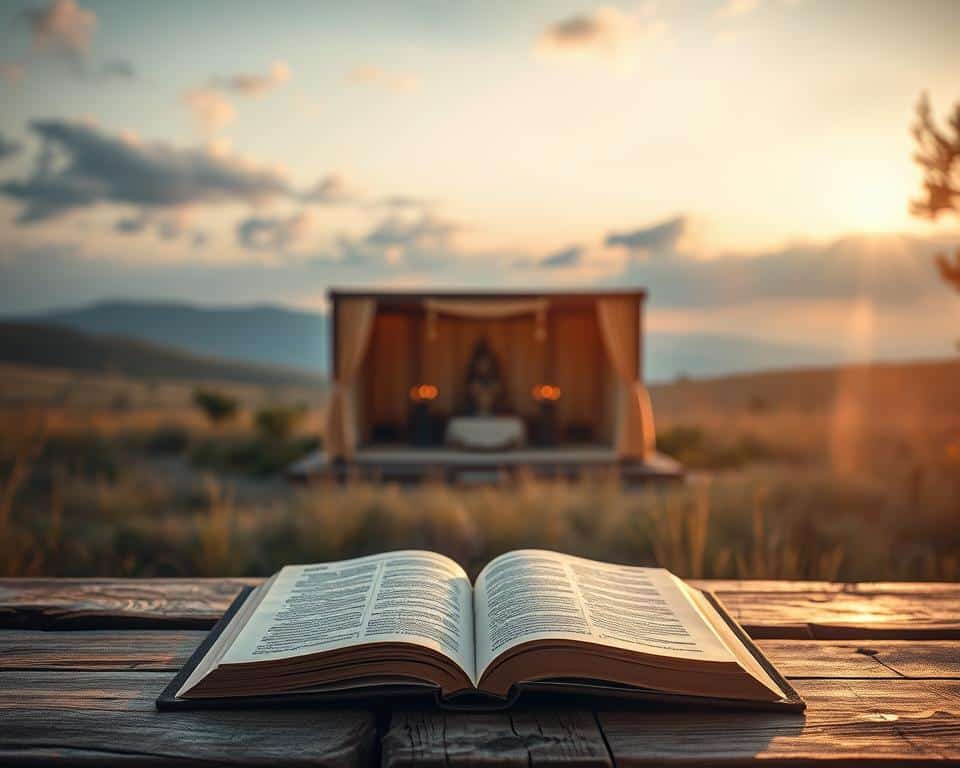
I invite you to walk with me into a tent that once held God’s presence in the wilderness, where the tabernacle shows how the Creator chose to dwell with people on earth. The image of a sacred tent at the camp center helps us see Scripture’s clear teaching about access to the Holy One, steps of service, and a path toward hope.
Scripture lays out this place in Exodus 25–31 and 35–40. I will explain the word’s biblical definition so you grasp its role across time. I describe the outer Holy Place, the inner Holy of Holies with a veil, and the courtyard with the bronze altar and laver.
Notice how layout, materials, and light mark growing holiness. Frames of acacia wood, gold overlay, silver sockets, and layered coverings made beauty that taught reverence. The entrance faced east, guiding worshipers from camp toward the presence of the Holy One.
As we go forward, I will keep language simple, follow the text closely, and invite you to read Exodus with me so Scripture shapes what we learn about God’s plan, place, service, time, and hope.
Key Takeaways
- The tabernacle shows God’s plan to dwell among His people in a central place.
- Exodus 25–31 and 35–40 give the core description found in Scripture.
- The layout taught graded access: courtyard, Holy Place, Holy of Holies.
- Materials and light signaled rising holiness and God’s presence.
- Priestly service at the altar and laver pointed to cleansing and service.
- I will guide you through word, structure, rituals, and theology step by step.
Search intent and what this ultimate guide covers
If you want clear facts from the biblical text about the tent, you are in the right place.
I write this article for people who seek a faithful, plain study of Exodus 25–31 and 35–40. The search intent here is informational. Readers want the facts, the structure, and the place of worship on earth.
What this guide covers:
- Etymology and key terms.
- Structure, layout, and location in the camp.
- Furnishings, priests, garments, and daily service.
- Rituals, calendar moments, and symbolic counts of lamps and loaves.
- Ancient parallels that place the tent in wider Near Eastern context.
- Historical movement from camp to Shiloh to Solomon’s Temple.
“I will use exact words and short sentences so you can extract facts fast.”
How to use this guide: Each section answers a clear question. Use the headings to find the part you need. Share it with others who study the tent as a meeting point between God and His people.
Tabernacle meaning and design
The ancient terms point to one clear truth: God meant to live among His people. The Hebrew mishkan literally reads as a “dwelling place,” a phrase that signals purpose. The “Tent of Meeting” (ohel mo’ed) stresses function—this was where God met Israel and spoke through Moses.
Latin tabernaculum and Greek skene both describe a tent or hut. Those words fit a portable plan suitable for a wilderness camp. Exodus uses these terms to teach form and function: a mobile holy place placed within the camp on earth.
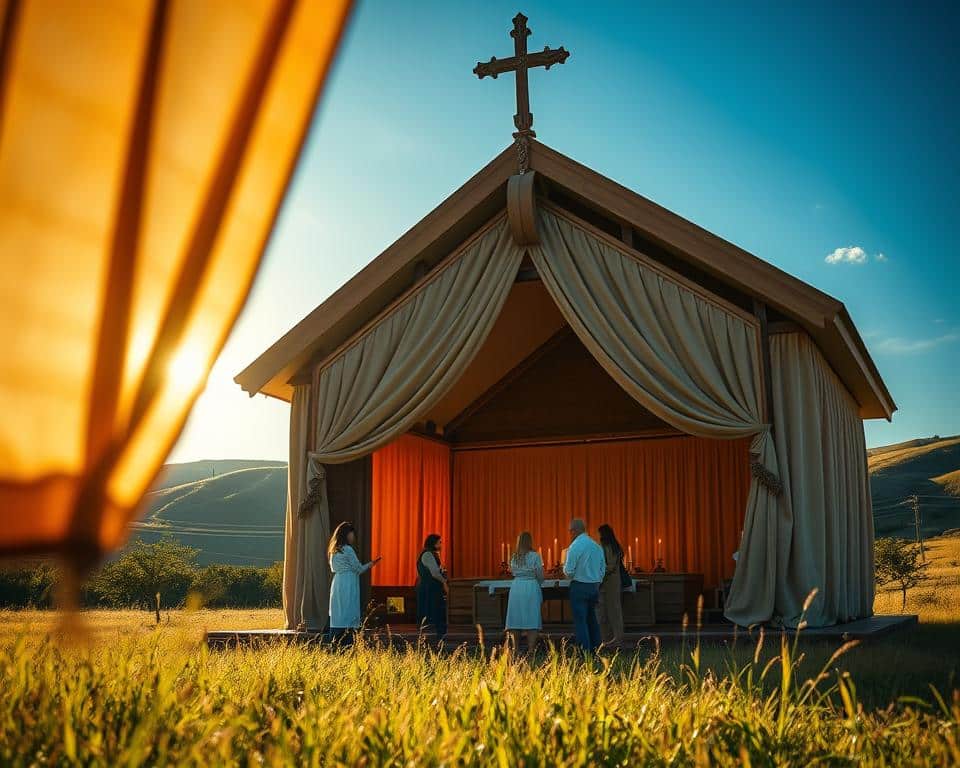
The two-room plan helped match function to form. The outer room served daily ministry while the inner room remained guarded for the Holy One. The table inside the holy place held twelve loaves, a weekly sign of covenant fellowship and time.
Materials, measured spaces, and specific furnishings all follow the word used for dwelling place. Design supports the message: God is present near His people, not distant on a mountain. Read Exodus and let Scripture set the terms for how this house teaches hope and access.
“Let Scripture shape our view of God’s house.”
The blueprint: structure, layout, and materials
I will lay out the tent’s measured plan so you can picture each side and room clearly.
Courtyard size and orientation
The courtyard measured 100 by 50 cubits. The entrance stood in the center of the east side to face the rising sun.
Frames, coverings, and curtain
The tent used acacia wood frames about 10 cubits high. Craftsmen overlaid the frames with gold and set each board in silver sockets.
Layers of fabric and skins covered the form. Woven linen formed inner coverings while outer skins protected the tent and marked rising holiness.
A heavy veil served as the curtain that split the two rooms: the Holy Place in front and the Holy of Holies behind it.
Zones by metal and room layout
Bronze dominated the court; gold worked inside the service room; silver served as bases and sockets. These metals marked ascending holiness by side and part.
The menorah stood on the south side of the Holy Place, the table on the north side, and the incense altar sat before the veil. The Ark rested alone in the inner room.
The precise measurements and construction made a stable tent in the wilderness that could be raised and taken down as the camp moved. I invite you to sketch this plan; seeing the form will fix the rooms and sides for what follows.
Furnishings and sacred objects inside the sanctuary
Inside the sanctuary each object speaks; I will name them and show their purpose.
Ark of the Covenant
Ark: A gold-overlaid chest in the inner chamber beneath cherubim on the mercy seat. It held the tablets of the ark covenant; Hebrews 9 notes added items like manna and Aaron’s rod. The ark marked God’s rule and promise.
Table of Showbread
Table: Placed on the north side of the room, it held twelve loaves. Priests replaced these each Sabbath. The loaves linked the twelve tribes to weekly cycles of time before the Lord.
Menorah and Altar of Incense
Menorah: A seven-lamp stand on the south side that gave ordered light within the place.
Golden altar of incense: Sat before the veil. Incense burned morning and evening to mark prayer and worship.
“Each object taught care, order, and mercy where God met His people.”
| Item | Primary Function | Room / Location |
|---|---|---|
| Ark of the Covenant | Seat of God’s rule; contained covenant tokens | Inner chamber under cherubim |
| Table of Showbread | Weekly covenant meal symbol; represented tribes and time | Holy Place, north side |
| Menorah (seven lamps) | Provided light; symbolized ordered service | Holy Place, south side |
| Golden Altar of Incense | Burned incense for prayer morning and evening | Before the veil in the Holy Place |
Zoning of holiness and access rules
The camp arranged holy space in clear layers so every person knew where to stand and who may serve. I will state the rules plainly and use exact terms so Scripture guides our view.
Court for the people and Levites
The outer court held the altar and the laver. The people could enter here to bring offerings and meet God through sacrifice.
Levites guarded and carried the sanctuary. They kept others from approaching the holy things and managed the altar service.
Holy Place for priests on duty
Only priests entered the holy place. They tended the lamps, burned incense, and changed the showbread as daily service required.
Holy of Holies for the high priest once a year
The curtain marked the inner boundary that no one crossed at will. The ark stood within that inner room.
Only the high priest entered the holy holies, and he did so once a year on the Day of Atonement with blood for the people. These rules kept life safe and taught God’s order.
“I will keep the camp in right standing through appointed service and careful guard.”
- The zones teach that God is holy and access follows His order.
- Levites handled transport and setup so the camp moved under care.
- These limits show mercy: God provided a safe meeting for sinners to draw near.
Priests, vestments, and daily service
Skilled hands shaped wood, gold, and fabric so the holy meeting place could stand among the people.
Bezalel and Oholiab led the work. Exodus names Bezalel son of Uri and Oholiab as the chief craftsmen. God gifted them to direct construction and to make the sacred vessels and garments. Skilled workers from Israel joined them to finish the building fit for God’s use.
Priestly garments and roles
Priestly dress used rich fabric, stones, and gold to mark service at the meeting place.
The garments included the ephod, the breastpiece, the robe, the tunic, the turban, and sashes.
The breastpiece bore the names of the tribes. The names kept the people before the Lord in every act of service.
The Levites and the high priest
The tribe of Levi received the charge to serve and to guard the sanctuary. They carried parts of the tent and kept order as the camp moved.
The high priest led oversight and the atonement rites. He entered the inner room on the appointed day and followed exact commands for the people’s sake.
“God chose people, set their dress, and defined their work to protect life and teach faith.”
| Person / Role | Primary Task | Materials / Markings |
|---|---|---|
| Bezalel & Oholiab | Lead craftsmen for construction and garments | Gold, acacia wood, fine fabric |
| Levites | Carry, guard, and manage the building transport | Assigned duties, ritual purity |
| High priest | Daily oversight; annual atonement rites | Ephod, breastpiece with tribes’ names, head-plate |
I will next describe offerings and calendar service the priests performed day by day. These acts show how ritual kept the camp in right standing before God’s word and gave steady hope to the tribes.
Rituals, calendar moments, and the meaning of sacrifice
The ritual life of Israel set rhythms by day, by season, and by the ark covenant at the center.
Daily acts shaped faith. Each morning and evening a priest burned incense on the golden altar to mark prayer. Lamps were tended so light stayed steady in the holy place.
Daily grain offerings and the listed guilt and peace offerings taught atonement, thanks, and fellowship under God’s word. The altar stood at the camp’s heart where blood made mercy visible for the people.
The Day of Atonement came once a year. The high priest entered the inner room with blood for cleansing as Leviticus records.
Purity rules guided service. Priests washed at the laver before they served. Levites carried the fittings and guarded the tent during travel in the wilderness, following Numbers’ commands.
“These rhythms formed a faithful people by schedule and law; mark them in study so worship gains shape and hope.”
Symbolism: creation, light, bread, and the dwelling of God
The tent’s signs teach in plain sight. I read Exodus to show how light, bread, and direction shaped worship and belief.
Seven lamps gave ordered light in the holy place. The seven-branch lampstand echoed the seven luminaries known in the ancient world. This linked the sanctuary to cosmic order and to God’s work of creation.
Twelve loaves on the table marked Israel before God. Replaced each Sabbath, the loaves tied tribes to weekly rhythm and to cycles of time familiar in Egypt and Mesopotamia. Such parallels help us read the table’s role with clarity.
The entrance faced east. Worshipers moved from camp toward the rising sun into a path that led from common space into the presence of God. Orientation turned movement into a teaching act.
“God used visible signs so children and elders would learn the same truths by what they saw.”
| Sign | Primary Link | Scriptural / Ancient Echo |
|---|---|---|
| Seven lamps | Cosmic order; light | Menorah in holy place; seven luminaries motif |
| Twelve loaves on the table | Time, tribes, covenant presence | Weekly replacement; parallels in Egyptian lists |
| East-facing entrance | Path toward presence | Entrance orientation; ritual movement from camp inward |
Form follows message: light, bread, and orientation taught creation order and covenant care. I keep these links close to Exodus so symbolism serves Scripture, not speculation.
Ancient Near Eastern and Egyptian parallels
Texts and finds from nearby cultures help us read the tent in its ancient context. Ugaritic and Mari sources use related words for tent frames that echo the Hebrew frame term. This link shows a shared vocabulary for wood frames and set-up.
Ugarit, Mari, and language links
Ugaritic texts use ’ohel and mishkan cognates and the frame term qrš. Mari records cite heavy frames called qersū. These language links align with Exodus terms for building and set-up.
Egyptian tent shrines and materials
Egyptian finds show gold-overlaid wood frames and dyed coverings in tent shrines. Tutankhamun’s frame and the Hathor shrine at Timna match the biblical layers and precious material use.
Rameses II’s camp plan and throne model
Reliefs of Rameses II show an east-facing rectangular court with a long reception room before a square back chamber. This mirrors a Holy Place before an inner throne room and helps us see the tent’s court and room arrangement.
Form, function, and sacred furniture
Winged emblems over Egyptian thrones echo the twin figures over the ark on the mercy seat. Artifacts also show arks and lampstands of similar craft. Such parallels support the view that the tabernacle was a real structure with a known regional form.
| Source | Parallel Feature | Implication for study |
|---|---|---|
| Ugarit / Mari | Shared frame terms (qrš, qersū) | Language ties link tent frames to biblical wording |
| Egyptian shrines | Gold‑overlaid wood frames; layered covers | Materials and layers reflect Exodus descriptions |
| Rameses II reliefs | East-facing court; reception tent before throne chamber | Camp plan models the camp’s side orientation and inner room |
| Royal iconography | Winged throne figures; arks and lamps | Visual motifs explain furniture form and the holy holies as throne space |
“These comparisons do not prove every detail, but they show the tent fits a familiar Near Eastern building model.”
Movement through history: camp, Shiloh, and Solomon’s Temple
I set out the sequence of moves so you can follow where worship stood over time.
From Sinai to Shiloh: After Sinai the Tent of Meeting settled at Shiloh. There the place served as the central worship site for the tribes and the priests who served there.
Ark at Kiriath Jearim and the tent in David’s time
The ark later stayed at Kiriath Jearim for a period while the tent and the altar continued at Gibeon. Kings and priests kept ritual life moving so people retained access to God’s covenant.
Temple dedication and the tent’s final mention
David brought the ark to Jerusalem and set it in a tent he pitched. At Solomon’s Temple dedication, priests carried the ark, the Tent of Meeting, and the holy vessels into the new house.
- The ark held the tablets and kept the covenant at the center of worship.
- Priests and the high priest acted as custodians in each move.
- The altar at Gibeon remained in use until the Temple became primary.
“The record names each place; it does not state the tent’s last location.”
Read Joshua, Samuel, Kings, and Chronicles with this route in view to trace each shift plainly.
Theological purpose: from Sinai’s distance to presence in the camp
From a distant mountain to a guarded dwelling in camp, Scripture shows how God moved His presence near the people in a measured way. The portable tent made mercy reachable while keeping holiness from harming the unprepared.
Why access is guarded and graded by holiness
Access was layered. The court, the holy place, and the inner room formed a clear path of approach. Numbers and Leviticus give commands that kept life safe and taught reverence.
The curtain and the cherubim marked the boundary between life and death. These signs warned worshipers and pointed to God’s order as mercy, not mere distance.
God’s dwelling with the people and the meeting in the tent
The dwelling place brought the ark and God’s rule into the camp. The inner room placed mercy at the center of worship so families could find hope under God’s care.
Daily service and annual rites flowed from this plan. Scripture grounds each rule in law and promise, so God’s word shapes both faith and obedience.
“A holy God chose to dwell among a sinful people and kept them safe by appointed ways.”
| Feature | Purpose | Scriptural basis |
|---|---|---|
| Court | Public approach for offerings and teaching | Exodus, Numbers |
| Holy Place | Priestly service; sustained presence | Exodus 25–30 |
| Inner room (with ark) | Seat of God’s rule and mercy | Leviticus; Hebrews (echoes) |
Conclusion
Let us close by naming the clear lessons this portable sanctuary taught the people of Israel.
The tabernacle stood as God’s house among His people, a visible place on earth that made the Lord’s presence known day by day. Its zones, furnishings, and rites taught access by grace under God’s order.
Exodus 25–31 and 35–40 give the pattern; later pages of Scripture trace the move from camp toward a permanent house. Ancient parallels show the tent fit a royal model and support its historic reality.
I encourage you to read this article alongside Leviticus, Numbers, Joshua, Samuel, Kings, and Chronicles so the pattern settles in mind. Give thanks for mercy that meets us through God’s appointed way, and may Scripture deepen your faith and hope.