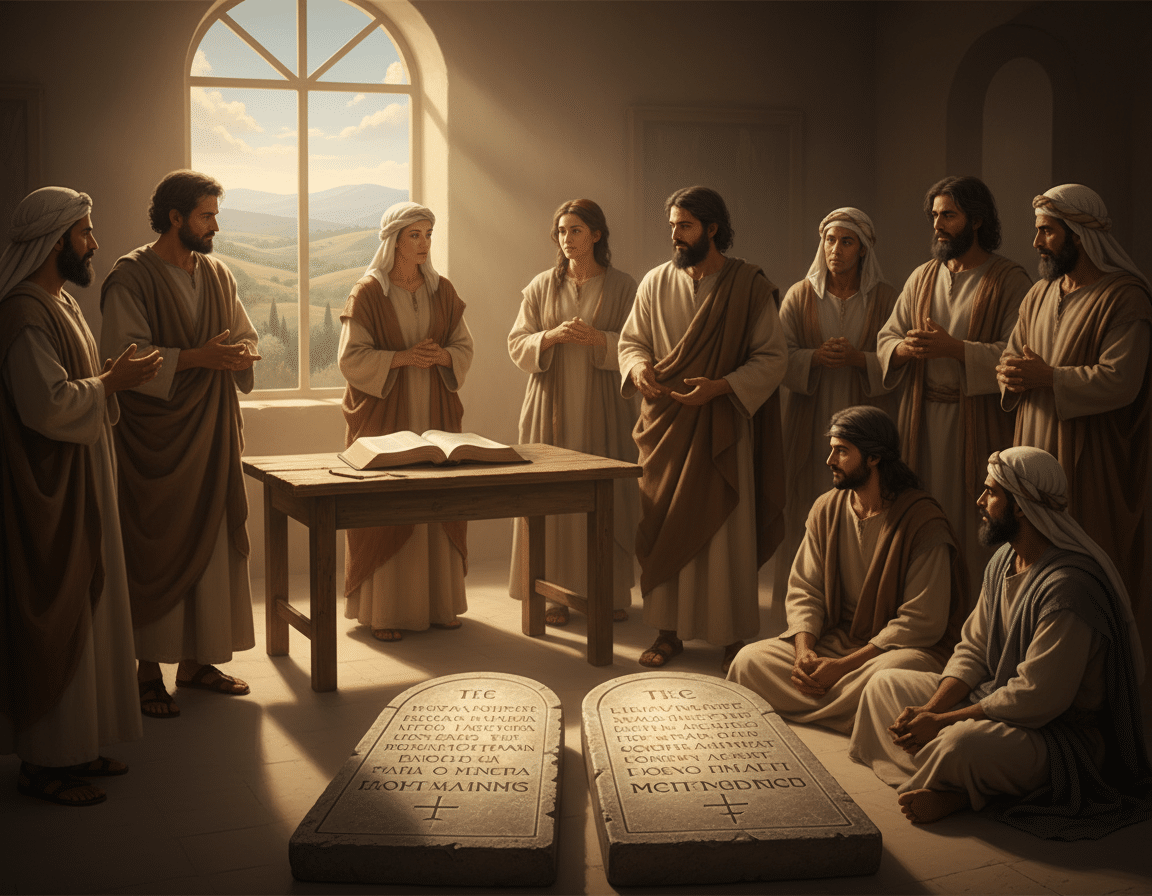

The first commandment means the God who rescued you gets all of your worship, and no rival is allowed near him. That is the first commandment meaning in one sentence. Exodus 20:2 has the LORD introduce himself as the God who brought Israel out of Egypt and out of the house of slavery, and only then, in Exodus 20:3, does he say, "You shall have no other gods before me." Grace comes first in the sentence and in the life. Obedience follows it.
Last updated: 2026-08-01
What does the first commandment mean?
Read the two verses together and the meaning is plain. Exodus 20:2 names the speaker: the LORD your God, the one who brought Israel out of Egypt. Exodus 20:3 gives the command: no other gods before him.
So the command is not "add me to your list." It's "clear the room." God claims your worship, your deepest trust, and the last word in your decisions.
Check it for yourself. Read the verses on either side of it and notice that God never argues for his existence here. He argues from his rescue.
The command opens with a rescue, not a rule
God introduces himself as a Redeemer before he introduces himself as a Lawgiver. He says he brought them out of the land of Egypt. He says he brought them out of the house of slavery.
That order matters more than most sermons on the topic admit. Israel was already free when they heard this. The law was not the price of the exodus; it was the shape of life after it.
Deuteronomy 5:6-7 says the same thing again, identifying the LORD as Israel's God who brought them out of Egypt and then commanding them to have no other gods. Moses repeats the rescue because people forget it. We still do.
Here's what that means on a Wednesday. You don't keep the first commandment to get God. You keep it because he already came and got you.
"No other gods before me" means no rival in the room
The phrase "before me" isn't about ranking. God is not asking for the top slot on a list where other gods hold second and third place. He's saying nothing else may stand in his presence as a god at all.
That rules out three things at once: another object of worship, another final source of security, and another final authority. If something else decides what's true when Scripture disagrees with it, that thing has taken God's chair.
The strongest objection here is a fair one. Someone will say this was addressed to people surrounded by Baal and Molech, so it has nothing to say to a person who owns no statue. But the text forbids other gods, not other carvings. What you carve is the second commandment's concern.
First and second commandment: what each one forbids
The Reformed tradition numbers the prohibition against other gods as the First Commandment and the prohibition against graven images as the Second Commandment. Jewish, Roman Catholic, and Lutheran lists divide the same words differently, which is why a friend's catechism may not match yours. The Ten Commandments don't change; the numbering does.
| Forbids | The question it asks you | |
|---|---|---|
| First commandment | Any rival god | Who do you worship? |
| Second commandment | Images and false likenesses of God | What do you think he's like? |
The distinction is worth keeping straight. One guards God's exclusivity. The other guards his character against your imagination. For a closer look at the second, see what the second commandment teaches.
What can become a god in an ordinary week?

Almost anything, and rarely anything ugly. Matthew 6:24 records Jesus saying that a person cannot serve both God and money. He didn't pick money because money is evil. He picked it because money is useful, respectable, and quietly demanding.
Run the test on your own week. Ask what you turn to first for safety, what you'd protect at almost any cost, and what you'd disobey God to keep.
- Money and the security it seems to promise
- Work, and the identity a title gives you
- A relationship you'd lie to hold on to
- Your own preferences, treated as the final court
- A political side you defend more carefully than you defend the truth
Notice that most of that list is made of good gifts. Idolatry is usually a good thing promoted past its pay grade. Jeremiah 2:13 pictures it as leaving a fountain of living water to dig your own cisterns, and the cisterns leak.
Knowing the true God means letting him describe himself
Obedience starts with receiving God as he reveals himself. He is holy, he is present, and he rules whether or not you consent. Exodus 20 gives you a God who speaks, not one you assemble.
The modern version of idolatry rarely bows to anything. It edits instead. Keep the mercy, drop the judgment, keep the comfort, drop the commandments, and you have a god who never contradicts you.
I'd rather say it plainly. A god who agrees with everything you already wanted is a mirror, and mirrors have never saved anybody.
How Jesus states the heart of the command
Jesus was asked for the greatest commandment and answered from Deuteronomy 6:5: love the LORD your God with all your heart, soul, mind, and strength. Matthew 22:37 and Mark 12:30 both put love at the center of loyalty.
Some people treat that summary as a replacement, as though love quietly retired the command. Read it the other way. Love is what the command was after the whole time.
Jesus also lived it under pressure. In Matthew 4:10 he answers the offer of every kingdom with a refusal and a quotation: worship the Lord your God and serve him only. The offer was real, and he turned it down without negotiating.
Where the text ends and the Adventist reading begins
Scripture states this much: God rescued his people, God claims exclusive worship, and anything given his place is an idol. Every Christian who reads Exodus 20:2-3 lands there.
Here's how Adventists read it. If God's claim rests on his identity as Rescuer and Creator, then worship isn't only an attitude, it shows up in what you do with your time. Revelation 14:7 calls people to worship him who made heaven and earth, which is the language of the fourth commandment.
So we connect the first commandment to the seventh day, sundown to sundown. The link is a conclusion drawn from the texts, not a line quoted from Exodus 20:3, and you should weigh it yourself. If you want the longer case, read how Adventists uphold the Ten Commandments and why the Ten Commandments still matter today.
A self-check you can run tonight
Don't ask yourself whether you love God. Everyone says yes. Ask questions that have evidence attached.
- Where do you turn first when you're frightened about money?
- What gets your best hours, not your leftover ones?
- Whose disapproval actually changes your behavior?
- What would you refuse to give up if God asked for it?
- When your desire and God's word disagree, which one gets rewritten?
The last question is the whole commandment in miniature. Answer it honestly and you'll know where you stand.
Daniel 3 shows what the answer costs when the pressure is public. The men who would not bow were thrown in anyway, and the rescue came in the furnace rather than instead of it. God is worth trusting either way, which is what they told the king before they knew how it ended.
What to do before next Sabbath
Name one rival out loud. Not a category like "materialism," but the specific thing: the account you check compulsively, the person whose opinion runs your week, the ambition you'd sin to reach.
Confess it to God in those words. Then take one practical step that limits its grip before sundown Friday. Move the app off your phone, give away a sum that stings a little, or say no to the thing you keep saying yes to.
Then set apart one act of worship this Sabbath that you'd normally skip. Grace first, obedience after. That's the order in Exodus 20, and it's still the order now.
FAQ
Was the first commandment only for Israel?
It was spoken to Israel, and it was never limited to them. God's claim rests on who he is, not on a nationality, and Jesus repeated the same demand for exclusive worship in his own ministry. Non-Israelites in Scripture are held to the same standard whenever they turn to other gods.
If I've made something an idol, do I have to get rid of it entirely?
Sometimes yes, often no. If the thing is sinful, it goes. If it's a good gift that grew too large, the fix is usually reordering rather than removal, since you can't throw out your job or your children. A useful test: can you set it aside for a Sabbath without anxiety?
Does breaking this commandment mean I've lost my salvation?
No. You're saved by grace through faith, and repentance is exactly what God invites when idolatry surfaces. What breaking it does mean is that something has your trust that cannot carry it, so the honest move is to say so and come back, not to quietly manage the guilt.
How do I tell devotion apart from idolatry when I love something good?
Watch what happens when it fails. Devotion grieves and keeps going. Idolatry collapses, because the thing was holding up your identity. Ask a believer who knows you well to answer that question about your life, and take the answer seriously even if it stings.