How did a set of covenant words change law, ethics, and public life across past centuries?
I write as a teacher who hopes to guide careful study of Scripture and its public reach. I will define the topic as the historical significance of the Ten Commandments in Scripture and society.
The Bible presents these commands as covenant words given to Moses. You will see three key texts: Exodus 20:1–17, Deuteronomy 5:6–21, and Exodus 34:11–26. I will explain why multiple versions matter for study and for history.
This Ultimate Guide will give clear sections and direct answers. I will trace how communities used these commands in teaching, worship, and public debate. I will treat Jewish and Christian traditions with respect and seek truth.
I will also note Islamic references to Moses’s commands and shared moral themes. For a focused study on law in Exodus, see this clear overview: what Exodus teaches about God’s law.
Key Takeaways
- We will ask how covenant words shaped law and public life.
- The Hebrew text offers three versions with distinct historical value.
- I will track use in teaching, worship, and civic debate.
- Jewish, Christian, and Islamic links will be treated with care.
- The guide gives clear, direct answers for readers in the United States.
What the Ten Commandments are and why they matter in history
I define key terms and show how brief covenant speech shaped law and life.
I call the set Aseret ha-Dibrot, which translates as “Ten Words.” In Greek the label is Decalogue. English readers often say ten commandments as a common name.

Decalogue and Ten Words
The phrase Ten Words points to covenant speech in Scripture. These are not a loose list but direct commands that set a bond between God and a people.
Ethics and covenant language
The commands function in the Hebrew Bible as covenant directives. They link God’s name and authority to moral duty. Short, clear commands have lasting power.
Their content guides worship, speech, time, and neighbor relations. Courts, families, and public life drew on these rules as a simple moral frame.
Where the Ten Commandments appear in the Bible
I trace the key passages that record this set and note what each passage adds to the story.

Three passages preserve this material. Each text plays a distinct role in Israel’s journey and covenant life.
- Exodus 20:1–17 — This passage places the words at Mount Sinai during the divine encounter. It is the Sinai event that frames the set as law given at a summit moment.
- Deuteronomy 5:6–21 — Here Moses retells the material to a later generation. This version links the commands to covenant renewal as Israel prepares to enter the land.
- Exodus 34:11–26 — Scholars often call this the “Ritual Decalogue.” It lists covenant rules with a different emphasis on cult and festival laws.
Readers should note that the book exodus gives more than one form. That fact invites careful comparison. It also explains why Christian teaching commonly treats Exodus 20 as the standard list.
These locations tie the texts to Israel’s march, to covenant renewal, and to questions about set tablets and writing. I will next examine how the narrative describes the tablets and God’s hand in making them.
The Mount Sinai story in the Book of Exodus
Exodus gives a clear timeline at Mount Sinai. It opens with thunder, lightning, cloud, a trumpet, and fire on the mountain. These signs set a public scene and shape how Israel responds.
Thunder, fire, and the people at the mountain
The people stand at the base and fear the voice of God. Scripture describes loud sounds and visible fire that cause awe and caution among the people.
Moses as messenger and the “book of the covenant”
Moses acts as God’s messenger. He receives statutes and writes laws into the book of the covenant. He reads that book aloud, and the people agree to obey in covenant language.
Forty days and the seventh day detail
The narrative notes six days of cloud, then Moses enters on the seventh day. He remains forty days and forty nights on the mountain.
| Time marker | Action | Meaning |
|---|---|---|
| Six days | Cloud covers mountain | Preparation and separation |
| Seventh day | Moses ascends | Rest motif linked to Sabbath |
| Forty days | Moses receives law | Establishes covenant instruction |
Two tablets, stone tablets, and the Ark of the Covenant
I will define terms and trace events in order so readers can follow how Scripture links law to a sacred object.
“Finger of God” writing and the first set
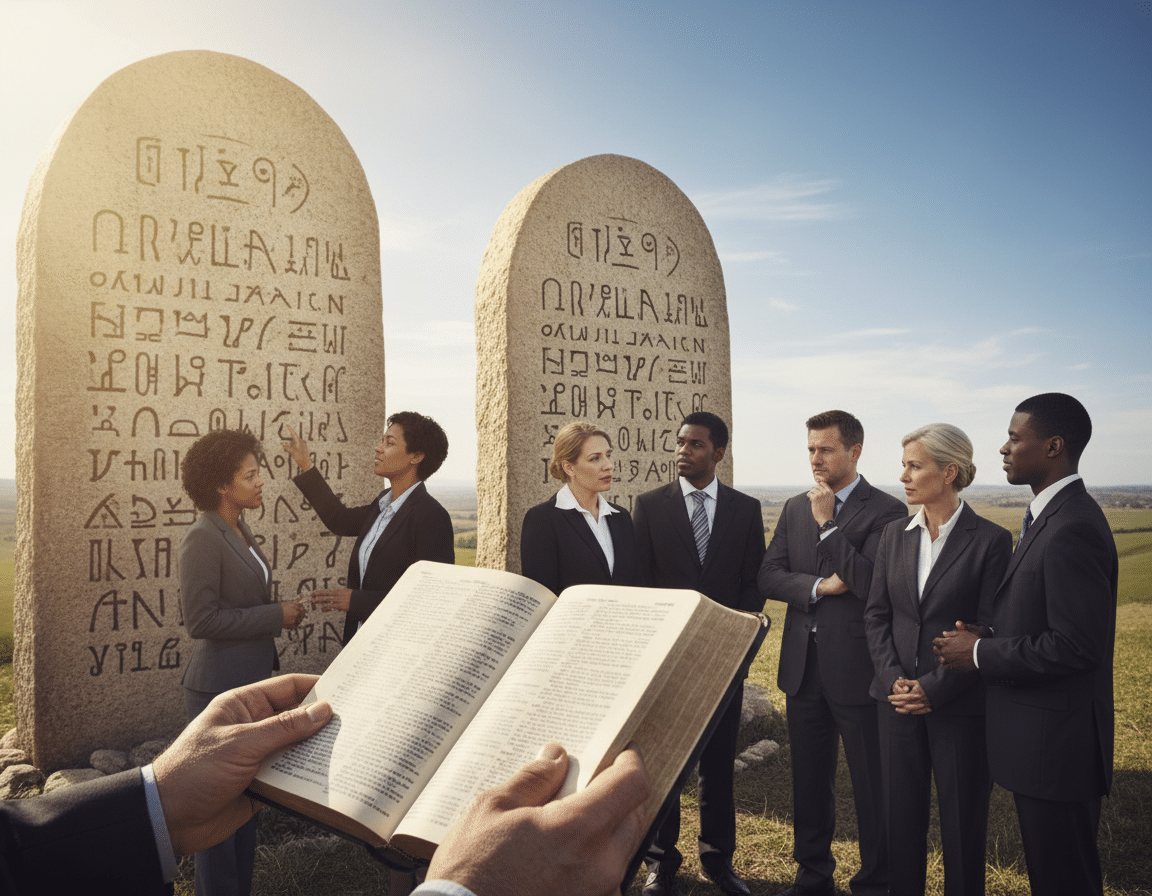
Exodus 31:18 says God gave Moses tablets written by the finger of God. That detail marks the words as divine speech carved into stone.
Moses breaks the tablets after the golden calf
When Israel built the golden calf, Moses shattered the first tablets in anger (Exodus 32). The act shows how sin breaks covenant witness.
The second set and placement in the ark
God commands a second set of stone tablets (Exodus 34; Deuteronomy 10). Scripture then places these tablets in the ark covenant, where they serve as a central witness.
What “tablets of the covenant” means
The Hebrew phrase points to physical slabs that carry covenant words. In short, the stone tablets function as durable proof of God’s law and promise.
- Two tablets became a lasting image for God’s word and covenant.
- Scripture links the first set to divine writing and the second to renewal after sin.
- Placement in the ark covenant shaped later reverence and public memory.
Taken together, the tablet narrative ties sin, repentance, and covenant renewal to a visible object that guided Israel’s faith and public life.
Historical significance of the Ten Commandments in law and public ethics
A brief set of clear directives can shape law and daily life across generations. I will show how short, memorable rules influence courts, schools, and private conduct.
How short commands work as core rules
Short phrasing helps a commandment serve as a core rule. People recall simple words more easily. That recall gives them practical force in family and civic settings.
Ritual rules and social rules linked
Commands about worship sit beside commands about neighbors. Ritual duties shape public trust, while social duties protect life and speech. Together they guide daily choices and public policy.
Why they became a symbol of moral order
Stone tablets and public reading made these commands a shared symbol. Communities use that image to signal order and duty. Yet a symbol can cause conflict if it is forced into politics without care.
| Function | Example | Public effect |
|---|---|---|
| Memory aid | Short law phrases | Wider civic teaching |
| Ritual link | Worship rules | Community trust |
| Social norm | Neighbor rules | Respect for life |
How religious traditions group and number the commandments
I note that the biblical passages present the material as flowing speech rather than a numbered list. Exodus 20 and Deuteronomy 5 read as continuous covenant address. Readers must pause to divide phrases into teachable units.
Why communities aimed for ten
I explain that groups sought a neat set for memory, instruction, and catechism. A fixed list helped worship, schooling, and public display.
Major numbering patterns
- Jewish tradition: Often counts “no other gods” and “no images” together or separates by classical rabbinic divisions.
- Catholic & Lutheran: Frequently combine the image ban with the first commandment and split coveting into two items.
- Reformed & many Orthodox: Tend to separate “no other gods” from “no images,” keeping coveting as a single or split pair depending on phrasing.
The coveting lines change the tally when a tradition divides desire for a house from desire for a spouse. Such choices shape catechism, preaching, and public plaques.
Focus on the full text rather than a favored numbering. The divine words and God’s name guide faithful reading more than any single count.
Commandments as teaching tools and memory aids
Short, clear lines help people hold God’s words in mind and pass them to children.
The second-person “you” makes instruction personal. When Scripture speaks to “you,” each listener feels addressed. That direct voice aids memory and shows faith as a personal duty.
Second-person phrasing and direct instruction
Using “you” turns law into guidance for daily life. Parents and teachers can speak a short line and a child will understand who must act.
Counting to ten and recitation in community life
A compact list fits recitation in homes and worship. People used finger counting and short time slots to check each item. That habit kept a faithful record across time.
Why some commands address desire and speech
Commands about coveting and false witness target heart and tongue. Honest speech builds neighbor trust and helps courts work rightly. Simple wording makes this clear for children and adults alike.
- Direct address: makes each command memorable.
- Short list: supports recitation and teaching at home.
- Focus on desire and speech: protects life and public trust.
The Ten Commandments in Jewish practice and Jewish law
For many rabbis, a concise set of divine sayings functions like a frontispiece to all Torah law. Jewish tradition treats those words as a core summary that points readers into a much larger legal world. They serve as headings that help organize teaching and moral focus.
Core of Halakha and relation to other rules
Halakha includes hundreds of commandments that shape daily life. Yet rabbis often return to the Ten Words as a quick guide to key duties.
These brief lines act as an organizing device. Teachers link specific halakhic rulings back to the summary phrases.
Daily recitation in the Second Temple period and why it stopped
Mishnah tradition reports a daily recitation in the Second Temple era. Leaders later halted public recitation to prevent claims that only this set mattered.
Some groups used the short list to deny other Torah rules. Rabbis therefore emphasized the full body of law and limited the daily reading.
Shavuot and Sinai focus in Jewish tradition
Shavuot marks the nation’s memory of Sinai and the giving of God’s word. Communities read and celebrate the covenant day with gratitude and study.
I invite Christian readers to learn from Jewish care for Scripture. Shared reverence for God’s word can support honest dialogue across faiths.
| Feature | Role in Jewish life | Legacy |
|---|---|---|
| Summary function | Guides teaching and sermons | Frames broader halakhic rulings |
| Second Temple recitation | Daily public reading | Stopped to protect full Torah |
| Shavuot observance | Annual Sinai remembrance | Strengthens communal identity |
How the Ten Commandments relate to the broader set of Torah laws
A short set of core commands often serves as an entry point to a much larger legal world in Scripture. I use that image to show how summary phrases help students sort detailed rules.
The “master key” teaching
Many teachers call the Ten Words a “master key.” That idea means a small list can point to themes found across many statutes.
Comparing ten with 613
Jewish tradition counts about 613 commandments in Torah. Teachers map those many laws to a few summary lines to aid memory and instruction.
- The short list highlights worship, Sabbath, and neighbor duties.
- It groups case laws and ritual rules under clear headings.
- It serves as a learning tool, not a replacement for full texts.
| Feature | Short set | Full corpus |
|---|---|---|
| Scale | 10 concise items | Approximately 613 detailed laws |
| Use | Memory and moral summary | Practical courtroom and cult rulings |
| Relation | Acts as organizing key | Needs context and narrative cases |
In Christian teaching many read the ten commandments as a moral core. Jewish practice also links that short part to a wider covenant law structure. Careful reading honors both the brief list and the fuller instruction in Scripture.
Key themes inside the commandments
I outline the main ideas within these laws and give clear, everyday examples for each.
Exclusive worship and gods
Scripture opens with loyalty: covenant begins when a people pledge exclusive worship to God. This command guards communal faith and public trust. A clear example: leaders must not replace worship with political loyalty.
Images, sacred speech, and the name
No carved images: this rule protects true worship and prevents religious shortcuts. It keeps focus on God, not objects.
Respect for God’s name: the command limits careless or false speech. Do not use God’s name to deceive or to swear falsely. In court and conversation, truth about God matters.
Sabbath day and weekly rest
The Sabbath day sets a weekly rhythm for rest and worship. Scripture links this day to creation and to God’s saving acts. Communities keep one day each week for worship, study, and care for neighbors.
Honor, family, and social order
Honor father mother serves as a bridge between worship and neighbor care. Respect for parents supports stable households and civic order. Obedient children learn duty and communal responsibility.
Limits that protect life and neighbor
Commands against murder, adultery, theft, and false witness protect life, marriage, property, and justice. The rule on coveting targets inner desire because unchecked desire often leads to harm. These lines form a practical moral frame for daily life.
“Love your neighbor” as law expressed in concrete limits is a summons to live honestly and protect one another.
- Exclusive worship prevents divided loyalties.
- Image and name rules guard true worship and truthful speech.
- The Sabbath day preserves rest tied to creation and redemption.
- Family honor links private duty to public stability.
- Neighbor laws protect life and promote justice.
How Christian traditions used the commandments in moral teaching
I write as a Christian teacher who sees how these short words guide preaching, catechism, and disciple-making. Churches use them as a moral map that links worship to daily conduct.
Common moral focus and points of difference
Most traditions agree that the set holds divine authority for moral life. Ministers preach loyalty to God, honest speech, and love of neighbor as core lessons.
Differences show up in numbering and emphasis. Some groups combine the image rule with the first line. Others split coveting into two teachings. These choices shape catechisms and sermon outlines.
Sabbath and the “Lord’s Day” shift
Many churches shift Sabbath observance into Sunday worship, calling it the “Lord’s Day.” This change affects weekly rhythm and public worship practice.
Seventh-day Adventists keep the seventh-day Sabbath as a direct commandment. Other communities honor Sunday while keeping Sabbath principles of rest and worship.
| Tradition | Numbering focus | Weekly observance |
|---|---|---|
| Reformed | Separates no other gods and image ban | Sunday Lord’s Day |
| Catholic | Combines image ban with first | Sunday worship, sabbath principle |
| Seventh-day Adventist | Distinct coveting lines, historic framing | Saturday Sabbath kept |
Test every claim by Scripture and seek obedience born of faith and hope, not pride.
Parallels and differences in Islamic reference to Moses’s commands
In Islamic teaching, the commands given to Moses appear as lessons in monotheism and right conduct. The Qur’an honors Moses (Musa) as a prophet and recounts his call to worship one God and to live justly.
Shared focus on monotheism, justice, and righteousness
Both traditions stress one God and reject idolatry. This shared insistence on exclusive worship shapes communal life and public ethics.
Justice and honest speech are central. Islamic texts praise truth-telling, fair transactions, and protection of family and property in ways that parallel biblical rules.
Clear differences in wording and context
The Qur’anic accounts use different phrasing and sit inside distinct legal and liturgical frames. Islamic law and later practice developed separate norms even when similar moral goals appear.
“Speak with truth and kindness”
Practical overlap in a diverse United States
These shared aims can support neighbor respect across faith lines in American civic life. Where wording differs, common moral goals still help communities cooperate on justice, charity, and family welfare.
- I note that Islam honors Moses and values laws that back justice and right conduct.
- The rejection of idols and focus on one God is a clear shared point.
- Parallel rules on honesty, harm, and family order appear, though the phrasing and practice differ.
- Differences in wording, context, and religious development matter and should be respected.
- I encourage Christian readers to compare claims with truth and kindness in public conversation.
Debates about origin dates and historical context
Scholars disagree about when this compact covenant material reached its final written form. Some date portions early, while others see later editorial shaping. These claims rest on literary clues, comparative texts, and how versions differ in the Hebrew Bible.
Scholarly proposals on when the Decalogue took shape
Researchers propose a range of time frames: pre-monarchic oral roots, early monarchy composition, or later priestly editing. I describe these as claims. Each claim reads language, setting, and manuscript layers differently.
Ancient treaty form comparisons and covenant framing
Some scholars compare the form to Near Eastern treaties. In plain terms, those treaties begin with a rescue or prologue, then list loyalty rules and penalties. That fits how Exodus links rescue from Egypt to a call for loyalty.
- Why debate matters: multiple versions in Scripture invite careful study, not quick conclusions.
- Academic note: work by David M. Carr (Oxford University Press) discusses memorization and form features.
I separate scholarly models from Scripture claims. Careful reading honors God’s word while using history and context to inform interpretation.
Criticism, misuse, and claims of harm in later history
Debates have often centered on how brief covenant words were turned into tools of coercion.
Some critics say a single commandment became a license for harsh punishment or violent acts in later eras. Scholars and critics point to episodes where leaders read short lines as blunt policy, not careful case law. That history matters for honest study.
Why misuse happens: short, memorable lines invite confident but narrow readings. Readers can add penalties or policies the text does not state. Without attention to broader scriptural law, a simple rule can be stretched beyond its meaning.
Examples and categories
- Forced religion: rulers using a command to demand public conformity.
- Selective quoting: lifting one line while ignoring wider case rules.
- Political weapon use: invoking a short rule to justify exclusion or force.
How to respond: read Scripture with care. Note what the wider laws say about intent, testimony, and punishment. Teach with Christ’s love as the guiding aim so God’s word keeps its true power and meaning.
“Faithful reading asks what the text says and what it does not say.”
The Ten Commandments in the United States today
In many American public spaces, a familiar stone image raises questions about law, faith, and government.
Displays in public spaces and schools as a legal issue
Courthouses, schools, and city halls are common places where people see plaques and tablets. Such displays prompt debate because government sites carry special weight for citizens.
Separation of church and state conflicts
The core dispute asks whether a government display endorses religion. Courts weigh whether displays serve a secular purpose or promote a faith.
Recent laws and legal challenges
States like Texas and Louisiana passed laws that require or protect certain displays. Those laws face legal review as plaintiffs argue about endorsement and coercion.
Different people make different claims: some say these words are part of public heritage and moral teaching. Others say mandated displays pressure nonbelievers and blur lines between faith and government.
“Faithful public speech must seek truth and fairness while respecting neighbors who differ.”
I urge Christians to speak with honesty and charity in these debates. Respectful dialogue helps keep public life peaceful and honors God’s word as we engage our neighbors.
Ten Commandments in art, film, and popular culture
Across stage and screen, a few powerful scenes kept an ancient set of laws in modern view. I note how filmmakers and artists turned covenant material into a visual shorthand that audiences recognize worldwide.
Major films and stage references
Cecil B. DeMille’s epics fixed a Moses image and the tablets in public memory. His films shaped how many Americans picture the story and tablets in dramatic fashion.
Television and film later varied tone. Krzysztof Kieślowski’s Dekalog treats the moral lines as modern dilemmas. The American comedy The Ten and Mel Brooks’s satire use the list for humor while relying on audience recognition.
Why the tablets image endures
The two tablets and stone form a simple, lasting emblem. Designers use that icon because it reads fast: law, witness, and public duty are clear at a glance.
Cultural use keeps a biblical theme in view even where faith fades. As I watch these works, I see how art preserves memory and invites fresh questions about faith and public life.
“A single image can hold a long story.”
Conclusion
I close by noting how a short set of words kept law and worship linked across ages.
Scripture places those commands at Mount Sinai and ties them to God’s rescue when he brought the people out of Egypt. Exodus and Deuteronomy frame obedience as response to that deliverance.
The story of stone tablets and the ark covenant kept these lines in public memory. Teachers in Jewish and Christian practice built law and daily way from that book and set of rules.
When read in context, these lines protect life, truth, worship, and family. I urge you to read Exodus and Deuteronomy with care and prayer.
I end with hope: follow Christ by faithful obedience and humble love for neighbor. This is the clearest way to live God’s word today.