
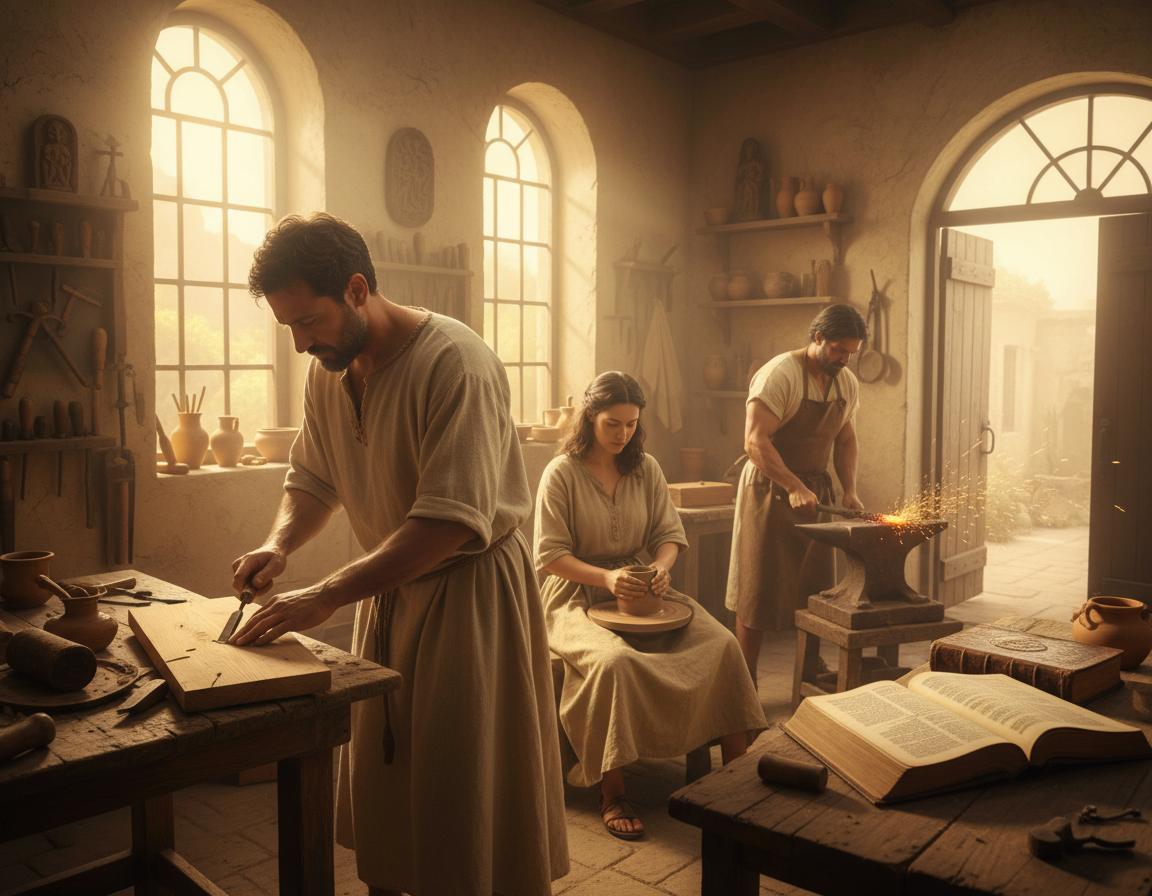
Martin Luther once said, “The Christian shoemaker does his duty not by putting little crosses on the shoes, but by making good shoes.” This idea has always stuck with me. It shows how our everyday tasks are deeply connected to our faith.
I want to explore the lives of skilled individuals in Scripture. We can see how God uses our daily work to show His truth. The Bible highlights the importance of manual labor and artistic talent. These are gifts from the Creator Himself.
My own journey led me to look at ancient workers. They contributed to building the Lord’s house. Their dedication provides a clear model for our modern lives.
These historical figures inspire us to bring our best to our own tasks. My goal is simple. I hope to help you see your daily efforts as a way to honor God. You can use your unique personal talents for His purpose. This truth connects to other biblical lessons from farming.
Key Takeaways
- Our daily work is a meaningful way to live out our faith.
- Scripture shows that skill and artistry are gifts from God.
- Ancient builders and artisans set an example of dedication we can follow today.
- God’s truth is revealed through the practical labors of His people.
- Your personal talents have a divine purpose in your everyday life.
- Honoring God can be part of any task, no matter how ordinary it seems.
The Historical Role of Craftsmen in Ancient Times
In biblical times, the labor of artisans was not just a job. It was a vital part of God’s plan for His people. We see this truth woven through the pages of Scripture.
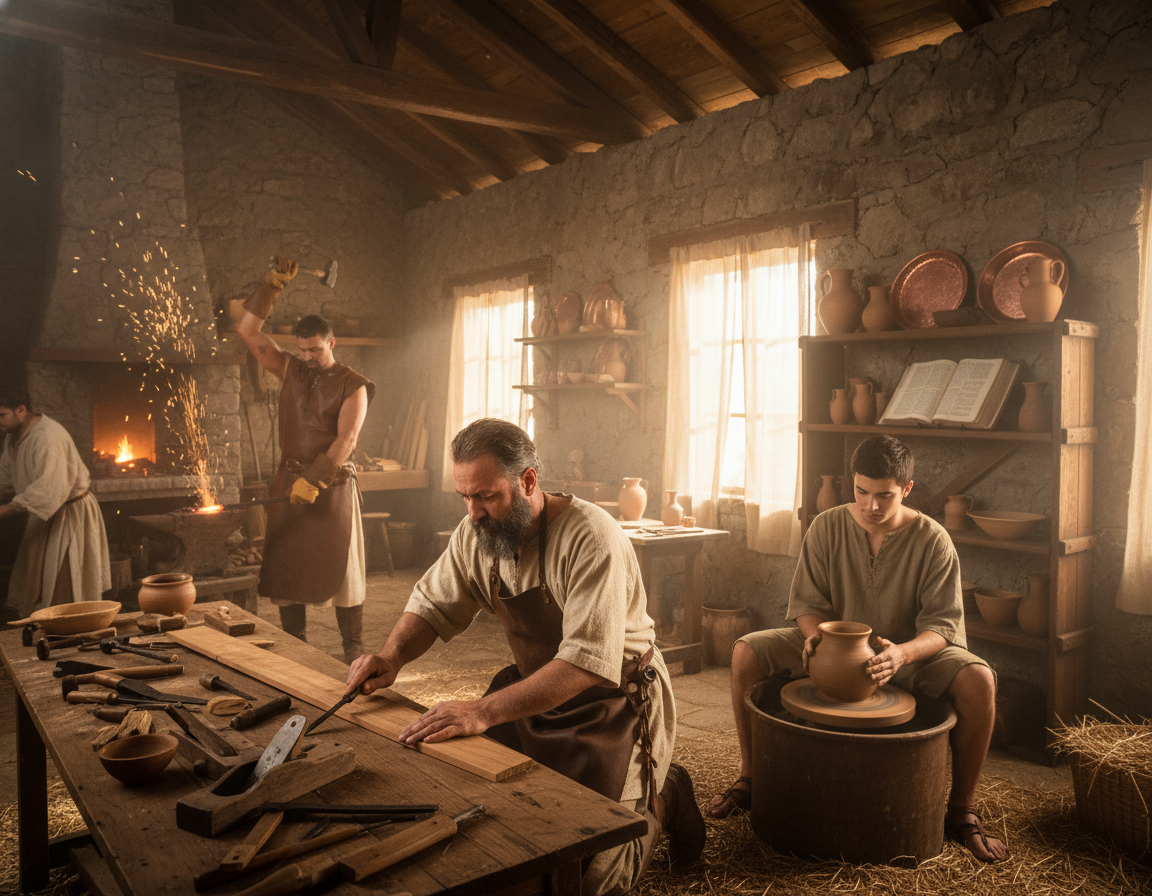
Overview of Work in Biblical Times
The book of Ezra tells us the Jewish returnees faced strong opposition. They worked to rebuild the altar and temple. For 16 long years, the temple site lay still.
An angel reported the earth was resting quietly. This meant the ruined temple’s status quo would continue. The order of work in those days involved both building and defending.
Key Figures and Their Skills
Second Kings 24:14 records a sad event. The king of Babylon took 10,000 captives. He carried away all the skilled workers and smiths from the land.
Every one of these individuals played a vital role. They were needed for the city’s restoration. A son from Tyre was sent to work with gold, silver, and bronze.
The Prophetic Vision in Zechariah
A vision of four horns and four craftsmen reveals God’s response to oppression. This passage gave hope to a people working to restore their community.
The Vision of the Four Horns
In Zechariah 1:18, the prophet saw four horns. They symbolized the kingdoms that had attacked the land of Judah. These horns nations lifted their power to scatter God’s people.
The image was stark. It represented the forces that opposed the faithful remnant’s return.
The Message of the Four Craftsmen
God did not leave His people without an answer. He sent four craftsmen to terrify those horns. These skilled workers came to cast horns nations down.
Their mission was to cut off the power blocking the people’s work. This vision shows that God provides the way to overcome any opposition. The craftsmen were sent to rebuild temple structures and restore hope.
An angel in the vision asked how long until God showed mercy. The answer came through this promise of divine help. It reminds me that skilled labor, like the 70,000 who built Solomon’s temple, is part of God’s plan for restoration.
God’s Gift of Skills to His People
The story of Bezalel and Oholiab demonstrates how God empowers ordinary people for extraordinary tasks. He bestows specific talents for His holy purposes. Our abilities are not just our own.
They are divine gifts meant for a greater plan. This truth fills me with hope for my own daily work.
Bezalel and Oholiab as Examples
God chose Bezalel, son of Uri. He filled him with His Spirit. This divine filling gave Bezalel great wisdom and knowledge.
He could design beautiful objects for the sanctuary. The Lord also appointed Oholiab, son of Ahisamach. He assisted with artistic tasks.
Every skilled person mentioned in Exodus received special abilities. They worked with gold, silver, bronze, and fine fabrics. God values the labor of His people.
It is not just for leaders. The glory of the temple was enhanced by their dedication. A son of a craftsman today can seek the same wisdom. He can perform daily tasks for God’s glory.
Craftsmen in the Bible: Significance for Our Faith Today
God’s purpose for our labor extends beyond ancient times into our present day. The stories of skilled workers are not just history. They are a living blueprint for how we live out our faith now.
Lessons on Work and Faith
Our abilities are divine gifts. God gives skills to His people so they can contribute to the world. We serve Him with our whole heart.
Remember the four craftsmen in Zechariah’s vision. They were sent to terrify the horns and nations. This reminds us that God provides the tools we need to overcome challenges today.
Every craftsman must see talent as a gift. It should be used to bring glory to Him. The opposing forces in our lives are no match for the spirit that guides faithful work.
A son of a believer finds his way by using unique skills. He builds up the community. We must seek wisdom to see how daily labor fits God’s larger plan, much like Exodus teaches about God’s law.
The land we occupy is our workshop. Here, we demonstrate faith through quality and integrity in everything we do.
Modern Reflections on Biblical Craftsmanship
Our contemporary tasks find deep meaning when linked to biblical examples. The stories of skilled workers are not just history. They offer a blueprint for our lives today.
Connecting Ancient Skills with Modern Work
When we study bible passages, the four craftsmen become relevant. They were sent to confront the horns nations lifted against God’s people.
We face similar opposition in our world. The call to rebuild temple walls echoes in our own communities.
| Aspect | Ancient Context | Modern Application |
|---|---|---|
| Skill Source | God’s Spirit filling Bezalel | God-given talents in our jobs |
| Purpose | Restoring the land israel | Contributing to society |
| Challenge | Horns nations opposing work | Workplace obstacles |
| Guidance | Prophet‘s vision in Zechariah 1:18 | Scripture and prayer |
How Spiritual Guidance Shapes Daily Tasks
The prophet Zechariah shows God’s active care on the earth. An angel revealed truth about the horns and nations.
Our faith guides us to use skills for positive impact. A son of a craftsman can apply the same order from the book of Ezra.
The spirit helps us during difficult times. We remember God’s faithfulness to scattered Judah.
This truth encourages our return to Him in all we do. We work while waiting for Christ’s return.
Overcoming Pride and Embracing Humility
Fifteen years ago, I discovered a talent for drawing that would challenge my faith in unexpected ways. I enjoyed creating, but I struggled when my work did not receive enough praise. My skill slowly became a source of personal pride.
Learning from Biblical Teachings on Pride
A church series covered five key topics. The lesson on pride hit me hard. I had to confess I made my talent an idol.
We must avoid the trap the horns nations lifted against humility. Pride is a root of many struggles. The history of land judah scatter shows how arrogance causes rift.
The four craftsmen are a powerful example. They worked for God’s purpose, not human approval. I saw I used my skills to cast horns nations of pride instead of giving God glory.
Pride goes before destruction, a haughty spirit before a fall.
A son of a skilled worker must seek wisdom. The right way is to keep your heart humble. Focus your labor on the Lord’s will, not your own fame.
This truth helps us stand against the horns and nations of self-importance in our lives today.
Rebuilding and Restoration in Scripture
From broken walls to shattered communities, God’s plan often involves skilled hands for restoration. Scripture shows this truth through powerful stories. Our faith is built on these acts of renewal.
Examples of Rebuilding in the Bible
King Joash hired craftsmen to repair the Lord’s temple. They collected money for the work. Every priest had a role in this holy task.
Another king ordered builders to buy wood and stone. This was for necessary repairs. The people worked together to restore beauty.
| Rebuilding Project | Biblical Reference | Skilled Workers Involved | Divine Purpose |
|---|---|---|---|
| Temple Repair under King Joash | 2 Chronicles 24:12 | Craftsmen and priests | Restore proper worship |
| Temple Restoration under King Josiah | 2 Kings 22:6 | Craftsmen and builders | Renew the covenant |
| Jerusalem Walls under Nehemiah | Nehemiah 2-6 | Various artisans | Protect the community |
| Spiritual Restoration | Zechariah 1:18-21 | Four craftsmen | Overcome horns and nations |
The four craftsmen represent God’s power to fix what is broken. They confront the horns and nations of this world. A son of a craftsman today can help his local church.
We must never build an idol with our hands. Our labor should always honor the Creator. God’s people are called to restore faith foundations everywhere.
Conclusion
My hope is that you now see your own labor through a lens of faith and eternal significance. The four craftsmen from Zechariah 1:18 stand as a lasting sign of hope for God’s people. They confronted the horns nations that lifted against land Judah.
God provides the way to rebuild temple structures for our lives today. We must cast horns nations of pride and seek divine wisdom. Ensure your work does not become an idol.
A son of a craftsman can look back through the years and see God is still active on the earth. The prophet and the priest remind us our daily tasks are worship when done for His glory. For the first time, I understand my skills are a gift for the Lord’s return.
May we all use our knowledge to serve the world. Honor the Creator with your whole heart.