
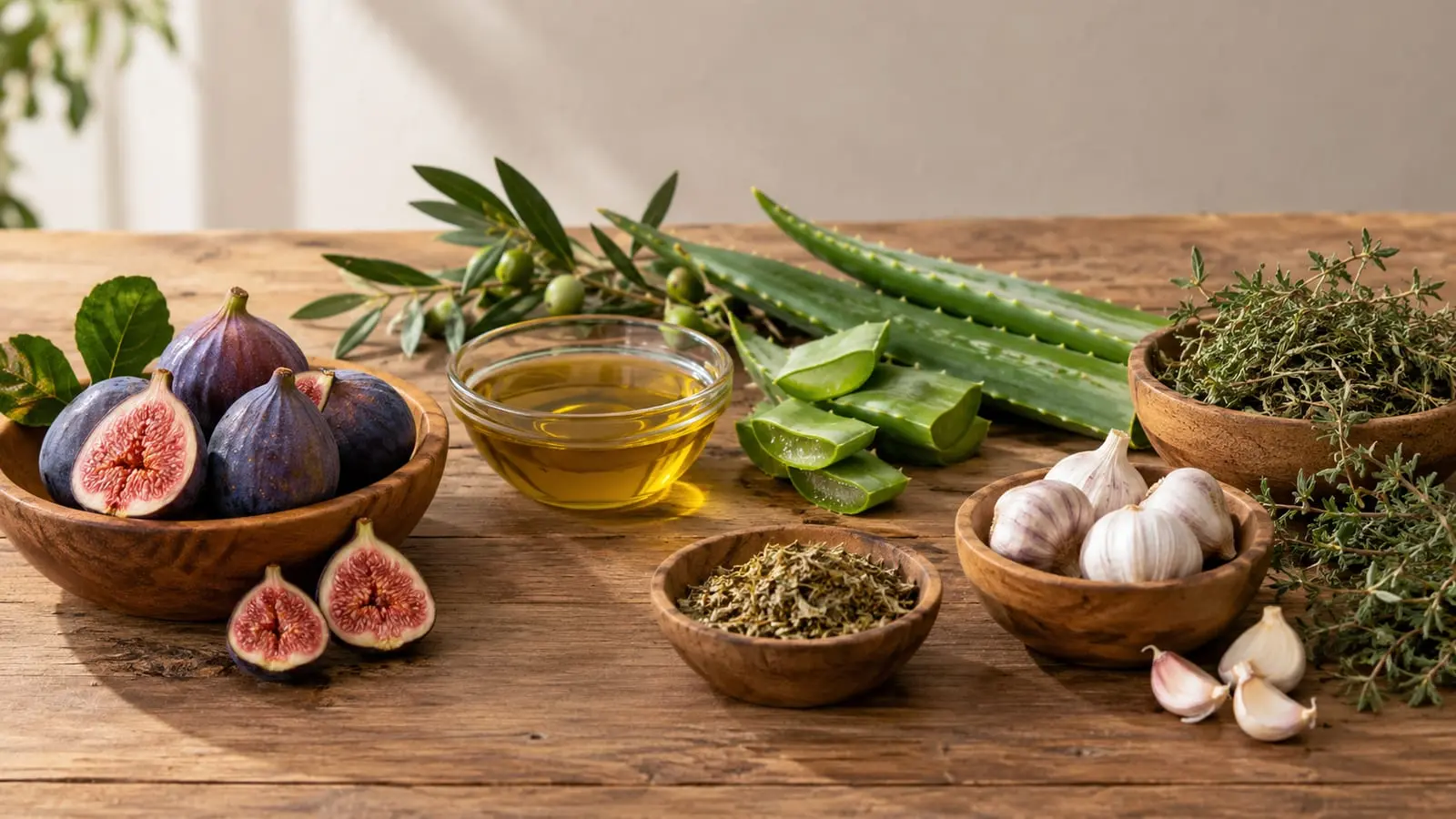
The ten strongest examples of natural remedies found in the Bible are olive oil, figs, hyssop, balm of Gilead, wine, aloe, myrrh, frankincense, mandrakes, and bitter herbs with garlic. Only a few are shown as actual care, most clearly oil and wine on wounds in Luke 10:34, a fig poultice on a boil in 2 Kings 20:7, and a little wine for the stomach in 1 Timothy 5:23. The rest appear mainly as food, fragrance, ritual, belief, or metaphor, so they show practical wisdom without forming a complete medical system. Scripture gives you passages to examine. It does not promise that olive oil, figs, herbs, or resins will cure every illness. Use the text honestly, pray for wisdom, and never replace competent medical care with a Bible cure that the passage itself never claims.
Last updated: 2026-10-19
What are the 10 natural remedies found in the Bible?
Here are the ten strongest examples. The verdict beside each one matters because a plant can appear in Scripture without being prescribed as medicine.
| Biblical substance or practice | Passage | What the text actually shows |
|---|---|---|
| Olive oil | Luke 10:34; James 5:14 | Wound care and anointing |
| Figs and a fig poultice | 2 Kings 20:7; Isaiah 38:21 | A plant preparation applied to illness |
| Hyssop | Exodus 12:22; Psalm 51:7 | Ritual application and cleansing imagery |
| Balm of Gilead | Jeremiah 8:22; 46:11 | A valued healing commodity and metaphor |
| Wine | Luke 10:34; 1 Timothy 5:23 | Wound care and limited medicinal advice |
| Aloe | Psalm 45:8; John 19:39 | Fragrance and burial material |
| Myrrh | Exodus 30:23; John 19:39 | Fragrance, anointing, and burial |
| Frankincense | Exodus 30:34; Matthew 2:11 | Incense and a valuable gift |
| Mandrakes | Genesis 30:14-16 | A fertility-related belief, without a promised cure |
| Bitter herbs and garlic | Exodus 12:8; Numbers 11:5 | Food and meal context, not universal treatment |
The Bible’s plain record is narrower than many online lists suggest. Some items are genuine care practices. Others are foods, perfumes, ritual materials, or symbols that later readers have turned into medical claims.
Olive oil
Olive oil is one of the clearest biblical examples of practical care. In Luke 10:34, the Samaritan poured oil and wine on the wounded man’s injuries and bandaged him. James 5:14 also describes church elders anointing a sick person with oil while praying.
The text shows care, prayer, and a physical act. It does not say olive oil guarantees healing or replaces diagnosis. Use the passage to remember that compassion may include ordinary treatment, a clean dressing, and a prayer beside the bed.
Figs and a fig poultice
Figs give you the clearest example of a plant preparation applied to illness. After Hezekiah became sick, Isaiah ordered a cake of figs to be applied to the boil in 2 Kings 20:7. Isaiah 38:21 records the same instruction.
Scripture does not explain how the fig preparation worked. It also does not turn fig poultices into a treatment for every skin problem. The safe conclusion is modest: an ancient plant preparation was used in this particular case, under prophetic instruction.
Hyssop
Hyssop appears chiefly in cleansing and worship. Exodus 12:22 says a branch of hyssop was dipped in blood and applied to the top and two side posts of the doorframe. Psalm 51:7 uses hyssop in David’s prayer for cleansing.
That is strong biblical evidence for ritual use. It is not proof that hyssop is a proven medicine for infection, cough, or disease. The common identification of biblical hyssop with a modern plant remains uncertain, as ancient plant names do not always match modern species.
Balm of Gilead
Jeremiah 8:22 asks, “Is there no balm in Gilead?” The question uses a known healing commodity as a picture of Israel’s deep wound. Jeremiah 46:11 also speaks of balm as a treatment sought for injury.
The balm was valuable, but Scripture does not give you its recipe or identify one guaranteed cure. The passage supports its reputation as a healing product and a trade good. It does not support every modern claim attached to the phrase “balm of Gilead.”
Wine
Wine appears in the Good Samaritan’s care for a wounded traveler. Luke 10:34 places wine beside oil, bandages, and transport. Paul also tells Timothy in 1 Timothy 5:23 to use a little wine for his stomach and frequent ailments.
That is limited medicinal advice, not permission for careless drinking. Scripture also condemns drunkenness in passages such as Ephesians 5:18 and Proverbs 20:1. The honest reading leaves room for a narrow use while rejecting intoxication and exaggerated health promises.
Aloe
Psalm 45:8 names aloe among fragrant substances. Proverbs 7:17 places aloe with myrrh and cinnamon in a perfumed bed. John 19:39 says Nicodemus brought a mixture of myrrh and aloes for Jesus’ burial.
John records the mixture as about seventy-five pounds, or about 34 kilograms. That detail tells you the material served a major burial purpose. The Bible presents aloe as fragrance and burial material, not as a commanded treatment for burns or disease.
Myrrh
Myrrh appears in the sacred anointing oil of Exodus 30:23-25. It also appears in Esther 2:12 as part of a woman’s preparation and in John 19:39 for burial. Matthew 2:11 records it as one of the gifts brought to Jesus.
These passages establish fragrance, anointing, value, and burial use. They do not give a biblical prescription for pain, infection, or inflammation. Later traditions may discuss those uses, but later tradition must not be placed in the mouth of Scripture.
Frankincense
Frankincense belongs first to worship. Exodus 30:34 includes it in the sacred incense, and Leviticus 2:1 places it with a grain offering. Matthew 2:11 records it as a gift to Jesus.
Frankincense smells good and carried value. That does not make it a biblical treatment for bodily illness. Burning it as incense or using its scent during prayer is a personal practice. Scripture does not command it as medicine.
Mandrakes
Genesis 30:14-16 records mandrakes in the rivalry between Leah and Rachel. Rachel wanted the plants, and Leah exchanged them for a night with Jacob. The passage records the belief that mandrakes related to fertility.
It does not approve that belief or promise that mandrakes cure infertility. The story shows family conflict, desire, and bargaining. It is a poor foundation for a fertility treatment and a good warning against turning a recorded belief into a divine endorsement.
Bitter herbs and garlic
Exodus 12:8 commands bitter herbs with the Passover meal. Numbers 11:5 says the Israelites remembered eating garlic, leeks, onions, cucumbers, and melons in Egypt. These verses place bitter herbs and garlic in food and memory.
Neither passage calls garlic a universal cure or identifies bitter herbs as treatment for disease. Food can support health without becoming medicine in every verse. Read the meal as a meal before you turn it into a medical chart.
For a broader look at food passages, see foods in the Bible.
How should you read an ancient remedy in the Bible?
Start by asking what kind of passage you are reading. The Bible contains several kinds of statements, and they do not all carry the same force.
- A narrative tells what someone did. The fig poultice in 2 Kings 20:7 belongs here.
- A command tells God’s people what to do. The bitter herbs in Exodus 12:8 belong here.
- A metaphor uses a known object to make a spiritual point. The balm in Jeremiah 8:22 belongs here.
- A food reference names what people ate. The garlic in Numbers 11:5 belongs here.
- A ritual instruction explains worship. Hyssop in Exodus 12:22 belongs here.
- A later tradition may describe a use that Scripture never states. Many claims about myrrh, aloe, and frankincense belong here.
Read the verses on either side of the claim. Ask who is speaking, what problem exists, and what the passage actually promises. A verse that names a plant has not automatically prescribed it.
The Bible also does not treat every physical problem as a spiritual failure. In John 9:1-3, Jesus rejected the assumption that a man’s blindness proved personal sin. That matters for natural remedies too. Illness is not always a puzzle you can solve by finding the right herb.
Biblical plants had a real historical setting
The people of the Bible lived among plants, oils, grains, trees, and resins. They cooked with them, traded them, burned them, applied them, and used them in worship. Scripture reflects that ordinary world.
Plant identification still has limits. Ancient Hebrew names do not always map neatly onto modern botanical names. A word translated “hyssop” may refer to a plant different from the one sold under that name today. The same problem affects terms translated as aloe, balm, cedar, and cinnamon.
That is why confident species lists often go too far. The Royal Botanic Gardens, Kew plant database can help you check modern plant names, but it cannot settle every ancient Hebrew identification.
Archaeology can show that people used a substance in a region. It cannot prove that every biblical mention had a medical purpose. A residue in a jar may point to trade, cooking, perfume, or worship. The passage still decides what Scripture itself says.
The strongest evidence concerns wounds and care
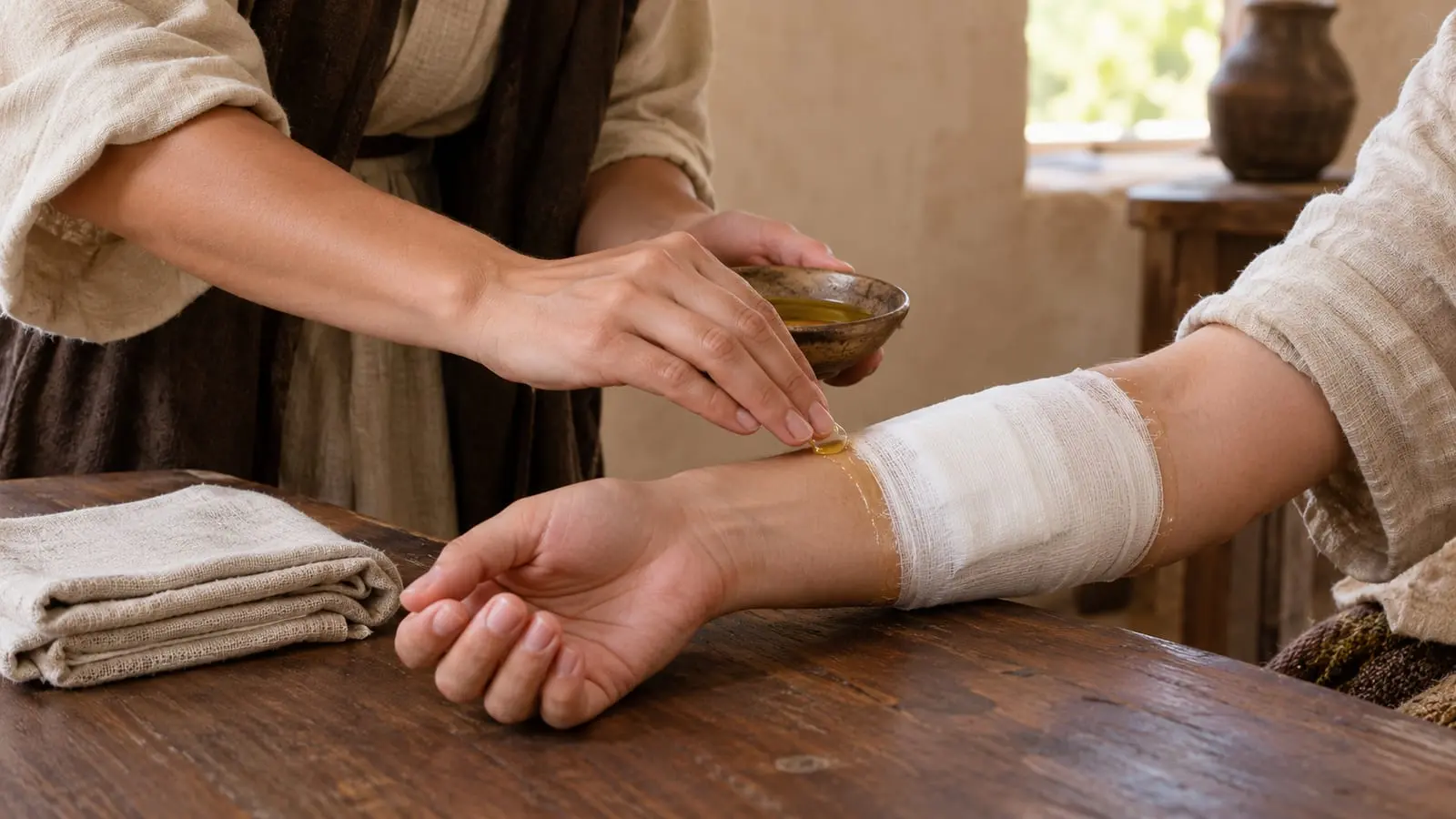
The Bible says more about practical care for wounds than it says about treating chronic disease. Luke 10:34-35 gives you oil, wine, bandages, transport, and payment for continued care. The Samaritan did not pray and walk away. He stopped, touched the wounds, and made arrangements.
That passage gives you a useful pattern for Christian care:
- Notice the suffering.
- Give practical help.
- Use ordinary means wisely.
- Stay involved after the first moment.
- Pay attention to continued needs.
The Samaritan’s example does not settle every modern medical question. It does settle one moral question. Compassion should have hands.
Figs provide a second example in 2 Kings 20:7 and Isaiah 38:21. However, the Bible gives no general rule for burns, rashes, tumors, or infections. Do not press one unusual case into a universal remedy.
Biblical remedies for digestion, breathing, and burns
The Bible gives a few limited references to personal health. Paul’s advice to Timothy in 1 Timothy 5:23 is the clearest digestive example. It mentions a little wine for stomach trouble and frequent ailments.
Scripture does not prescribe garlic for digestion, hyssop for asthma, aloe for burns, or frankincense for breathing problems. Those uses may appear in later herbal traditions or modern product claims. They remain separate from the Bible’s direct teaching.
The same caution applies to essential oils. A natural product can still irritate skin or interact with medicine. For example, topical peppermint oil can cause skin rashes and irritation. The National Center for Complementary and Integrative Health provides practical safety information about herbs and supplements.
For a small burn, wound, breathing problem, or stomach complaint, first judge the seriousness. Seek qualified medical help when symptoms are severe, persistent, worsening, or unusual. Prayer and treatment do not compete with each other.
Balm, aloe, myrrh, and frankincense were not all medicine
Ancient people used valuable substances for several purposes. Perfume could be part of burial. Resin could be burned in worship. Oil could serve in grooming, hospitality, anointing, or wound care.
The same ingredient could have different uses in different settings. That is why John 19:39 does not prove that aloe was a burn treatment. It proves that aloe and myrrh were part of burial preparation.
Exodus 30:23-25 makes the same point about the sacred anointing oil. It specifies 500 shekels of cassia and calls the mixture a sacred anointing oil, a fragrant blend, the work of a perfumer. This was a holy mixture for worship, not a household formula to copy casually.
The text draws a line around sacred use. You should draw one around medical claims too.
Ancient remedy claims outside the Bible need labels
The ancient Hebrews shared a wider Near Eastern world of food, trade, farming, perfume, and healing practice. Egypt and Mesopotamia also preserved plant-based treatments. Those records can help explain the setting, but they are not Bible verses.
A claim may therefore be true in one of three different ways:
- Scripture directly states it.
- History shows that people used the substance.
- Later tradition assigns a medical benefit to it.
Those are three different claims. Do not blend them into one sentence and call the result biblical evidence.
This distinction also protects you from marketing language. A product may use a Bible plant in its name while making claims the Bible never makes. Check the passage yourself. The label is not the authority.
Prayer, practical care, and medical help belong together

Prayer is not a substitute for responsibility. James 5:14-16 joins prayer, anointing, confession, and the care of the church. Luke 10:34-35 joins compassion with oil, wine, bandaging, transport, and money.
Jesus also recognized the ordinary work of physicians in Matthew 9:12. His point was that sick people need a physician, not that seeking care shows weak faith. In Luke 5:31-32, he used that common fact to explain his mission to sinners.
You can pray while making an appointment. You can ask God for healing while taking prescribed treatment. You can use food, rest, cleanliness, and modest home care without pretending that every illness has a hidden herbal answer.
Natural does not mean harmless. “Biblical” does not mean the passage promised your desired result.
The Adventist reading and the boundary of the text
Here is how Adventists read these passages. Scripture calls you to care for the body as part of faithful stewardship. First Corinthians 6:19-20 says your body is the temple of the Holy Spirit and that you should glorify God in it.
That supports prevention, temperance, wholesome food, rest, exercise, clean habits, and responsible treatment. It does not turn every traditional remedy into a command. The text states the duty to honor God with your body. The Adventist emphasis applies that duty through a whole-person health message.
Grace comes first, obedience after. Healthful living is a response to God’s gift, not a wage that purchases healing or salvation. You do not earn God’s favor by refusing a doctor or drinking an herbal tea.
Our Adventist approach to healthy living should make you steadier, not more fearful. If a health claim depends on panic, secrecy, or a promise of guaranteed healing, leave it alone.
One faithful step before next Sabbath
Choose one remedy from this article and read its passage with the verses around it. Write down what the text says, what it does not say, and what claim came from later tradition.
Then reject one unsupported cure claim. If you or someone in your home is sick, pray, use sensible care, and seek qualified help when needed. Let Scripture shape your stewardship without forcing it to say more than it says.
The Bible can bear your hardest question. It does not need a borrowed promise attached to it.
FAQ
Does the Bible teach that natural remedies are better than medicine?
No. The Bible records practical care, but it does not rank every natural substance above medical treatment. Luke 10:34 shows wound care with oil, wine, and bandages. Matthew 9:12 recognizes the ordinary need for a physician.
Can Christians use herbal remedies?
Christians may use herbs carefully, but they should check safety, interactions, and the seriousness of the illness. Scripture supports wise stewardship in passages such as 1 Corinthians 6:19-20. It does not promise that a product is safe merely because its ingredient appears in the Bible.
Did Jesus use natural remedies?
The Gospels do not give a broad record of Jesus treating illness with herbs. Jesus sometimes used physical actions, such as clay in John 9:6, but the passage does not present clay as a general cure. His healings depended on his authority, not on a recipe readers are told to repeat.
Does the Bible promise healing after anointing with oil?
No. James 5:14-15 connects anointing with prayer for the sick, but it does not make oil a guaranteed cure or a replacement for care. The promise rests in God’s mercy and power, not in the oil itself.
What should you do if a biblical remedy does not work?
Do not blame the sick person or assume hidden unbelief. Continue prayer and compassionate care, and seek qualified medical help. Jesus rejected the idea that every illness proves personal sin in John 9:1-3. I do not know why every person is healed in one case and not another, and Scripture does not ask us to pretend that we do.