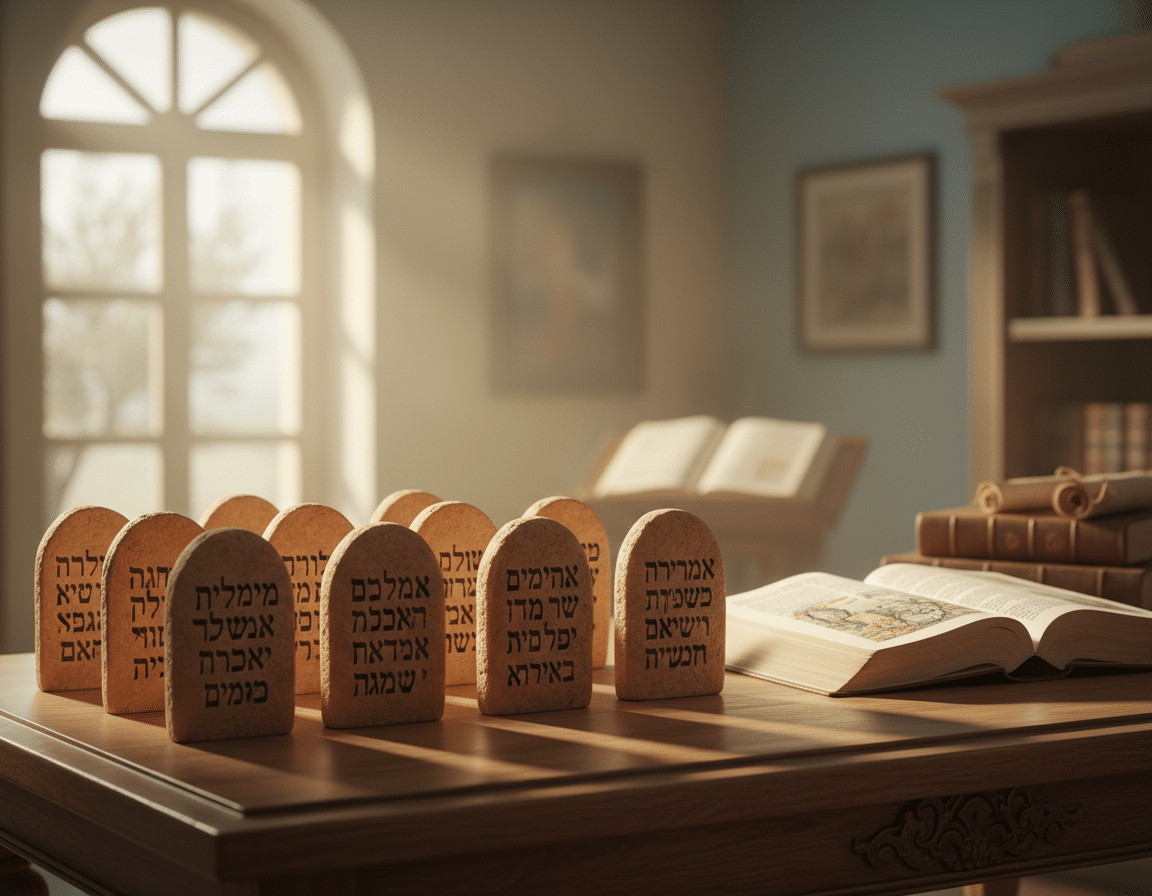
Keep the order. The Ten Commandments in order are: have no other gods, make no idols, do not misuse God’s name, keep the seventh-day Sabbath holy, honor your father and mother, do not murder, do not commit adultery, do not steal, do not bear false witness, and do not covet. Read the full passage in Exodus 20:2-17 because the Bible gives the commands, while the numbered divisions are a later interpretive convention. The list begins with grace and ends with the desires hidden in the heart. That order is worth keeping because God starts with worship and ends where no police report can go.
The Ten Commandments in order
Here is the common Protestant and Seventh-day Adventist sequence from Exodus 20:
| Number | Commandment | Passage |
|---|---|---|
| 1 | You shall have no other gods before Me. | Exodus 20:3 |
| 2 | You shall not make idols or bow down to them. | Exodus 20:4-6 |
| 3 | You shall not take the name of the Lord your God in vain. | Exodus 20:7 |
| 4 | Remember the Sabbath day and keep it holy. | Exodus 20:8-11 |
| 5 | Honor your father and your mother. | Exodus 20:12 |
| 6 | You shall not murder. | Exodus 20:13 |
| 7 | You shall not commit adultery. | Exodus 20:14 |
| 8 | You shall not steal. | Exodus 20:15 |
| 9 | You shall not bear false witness against your neighbor. | Exodus 20:16 |
| 10 | You shall not covet what belongs to your neighbor. | Exodus 20:17 |
Do not read that table as ten loose rules. Read it as one road. The first commandment sets the direction: “You shall have no other gods before Me” in Exodus 20:3. Start there. A person can sound religious and still put money, status, appetite, or approval above God.
Once worship is settled, speech follows. The third commandment says, “You shall not take the name of the Lord your God in vain” in Exodus 20:7. God’s name carries his character, so careless speech is only part of the issue. Claiming his authority while living against his ways also misuses his name.
The fifth commandment turns the road toward home: honor your father and your mother in Exodus 20:12, with a promise that your days may be long in the land the Lord is giving you. Then the commands walk out the front door. The sixth guards your neighbor’s life: “You shall not murder” in Exodus 20:13. The eighth guards his goods: “You shall not steal” in Exodus 20:15.
What does the order teach?
The order moves from worship to family, then to human life, marriage, property, truth, and desire. That order matters because the commands are connected. You can avoid stealing while still coveting, and you can speak religious words while worshiping something else.
If you want to memorize the list, use the sequence as a path through ordinary life. Start with God, then worship, speech, time, family, life, marriage, property, truth, and desire. These tips for memorizing the Ten Commandments can help you keep the order without turning it into a chant detached from the passage.
Exodus 20 begins with grace

The Ten Commandments begin with rescue. God says, “I am the Lord your God, who brought you out of the land of Egypt, out of the house of slavery” in Exodus 20:2.
That sentence comes before the first command. Israel does not obey in order to become redeemed. Israel obeys because God has already redeemed them. Grace first, obedience after.
The setting is Mount Sinai, where God makes a covenant with Israel. Exodus 19:4-6 describes God carrying Israel out of Egypt and calling them to be his treasured possession and holy nation.
So the commandments are not loose advice pinned to a wall. They are the covenant words given to a rescued people. Read Exodus 20 from verse 2 and the rescue stays attached to every command.
The common mistake is to read the list as a ladder to climb toward God. Exodus reads the other way. God saves, God speaks, and his people learn how to live with him.
The commands teach love with edges
The Ten Commandments show what love looks like when it meets real life. The opening commands direct your relationship with God, while the rest govern your relationship with other people.
Jesus gives the same shape in Matthew 22:37-40. Love God with all your heart, soul, and mind. Love your neighbor as yourself. He says the law and the prophets hang on those commands.
Love does not make the commandments unnecessary. Romans 13:8-10 says the commands against adultery, murder, stealing, and coveting are summed up in love because love does no wrong to a neighbor. Love without boundaries is often just permission wearing a pleasant shirt.
The commandments set moral boundaries around real harm:
- Idolatry bends worship away from God.
- False speech damages trust.
- Sabbath neglect turns time into a master.
- Murder destroys life.
- Adultery breaks covenant faithfulness.
- Theft takes what another person has not given.
- False witness can ruin a neighbor through words.
- Coveting feeds a hunger that possessions cannot satisfy.
That is why the list still speaks in a kitchen, a workplace, and a church pew. A command against stealing reaches the expense report. A command against false witness reaches the group chat. A command against coveting reaches the quiet ache you carry past the neighbor’s new car.
The commandments expose the life beneath the life
The commandments are not a list of penalties waiting for technical mistakes. They show you what kind of person your habits are making.
Proverbs 6:16-19 names several evils that match the commandments: pride, lying, violence, a heart that plans wickedness, and a false witness. The result is not a paperwork problem. Families break, trust dries up, and trouble gets handed to the next person.
Psalm 19:7-11 calls the law perfect, sure, right, pure, and true. It says God’s commands warn the servant and bring great reward. The reward is not a purchase price for salvation. It is the fruit of walking in a trustworthy path.
Consider the eighth commandment at work. “You shall not steal” in Exodus 20:15 reaches beyond taking cash. It speaks to dishonest invoices, missing inventory, unpaid debts, and property used without permission. Ephesians 4:28 gives the better direction: work honestly so you can share with someone in need.
The ninth commandment reaches a meeting where a coworker is absent. The tenth reaches the resentment that begins before any action. Scripture does not wait for the damage to become public before it calls the heart to account.
This is why the Ten Commandments still matter today. They catch the padded invoice before the audit does, and the envy before it has a name.
What does Decalogue mean?
“Decalogue” comes from Greek and means “ten words.” Exodus 34:28 and Deuteronomy 4:13 use that expression in Hebrew, the “ten words,” which English Bibles render as the Ten Commandments, and both verses tie them to the covenant.
The original Hebrew text does not print the title “The Ten Commandments” above the passage as a heading. “Decalogue” is a later label for that group of covenant commands.
The label is useful, but do not let it carry more weight than the text. A name can help you find the passage. It cannot settle every question about how the commands should be counted.
For the commands themselves, keep returning to Exodus 20 and Deuteronomy 5.
Exodus and Deuteronomy repeat the covenant
Exodus 20 and Deuteronomy 5 preserve the same covenant commands, but they present them in different settings.
Exodus gives the commands at Sinai after Israel leaves Egypt. Deuteronomy gives Moses’ address to the new generation before Israel enters the promised land. The first audience stands at the mountain. The second stands near the end of the wilderness years.
The Sabbath command shows the clearest difference in reasoning. Exodus 20:11 grounds Sabbath rest in creation: God made heaven and earth, then rested. Deuteronomy 5:15 grounds it in redemption: Israel was a slave in Egypt, and the Lord brought them out.
Those reasons do not compete. Creation and redemption meet in the Sabbath. God made you, and God rescues you. Your week needs both truths.
You will notice small differences in wording when Moses repeats the covenant. Do not build a second moral law out of them. The same God is giving the same commands to the generation that will live in the land.
Read Deuteronomy 5:6-21 beside Exodus 20. Let both passages speak before you try to make one line do all the work.
How are the Ten Commandments numbered?
Scripture does not attach ordinal numbers to each commandment. Exodus 20 gives the words in sequence, but it does not say, “This is commandment one,” followed by “This is commandment two.”
That is why Christian and Jewish traditions number the list differently. The words remain in the passage. The divisions vary.
The common Protestant and Adventist numbering treats these as separate:
- No other gods.
- No idols.
- Do not misuse God’s name.
- Keep the Sabbath.
- Honor parents.
- Do not murder.
- Do not commit adultery.
- Do not steal.
- Do not bear false witness.
- Do not covet.
Jewish tradition commonly counts God’s opening declaration, “I am the Lord your God,” as the first word. It then places the command against other gods next. Catholic and Lutheran traditions commonly combine the commands about other gods and idols, then divide the final command about coveting into two parts.
So a different numbering system does not mean a different Exodus passage. It means the tradition has drawn the lines in different places.
The mistake is to argue over the labels while ignoring the command against false worship, false speech, violence, theft, and desire. Read the verses before you defend the numbering.
Where does the text end and the Adventist reading begin?
The text plainly commands the seventh-day Sabbath in Exodus 20:8-11. It says to remember the Sabbath day, keep it holy, labor for six days, and rest on the seventh. Leviticus 23:32 reckons the Day of Atonement sabbath from evening to evening, and Adventists apply the same evening-to-evening reckoning to the weekly Sabbath, keeping it from sundown Friday to sundown Saturday.
The text also says the commandments were spoken by God and written on tablets. Exodus 31:18 describes the tablets as written with the finger of God. Deuteronomy 4:13 calls them the covenant God commanded Israel to keep.
Here is where Adventist interpretation begins. Adventists conclude that the Ten Commandments remain the binding moral law for Christians, including the seventh-day Sabbath. They connect Exodus 20 with Jesus’ teaching in Matthew 5:17-20, Paul’s statement in Romans 3:31, and the end-time description in Revelation 14:12 of those who keep the commandments of God and the faith of Jesus.
The biblical wording and the Adventist conclusion should not be blurred. The wording says seventh day. The Adventist reading says that command still applies to followers of Jesus.
Does grace make obedience meaningless?
The strongest objection is that Christians are under grace, not law. It deserves a straight answer. Ephesians 2:8-9 says salvation is God’s gift and not a result of works, while the next verse says believers are created in Christ Jesus for good works. Grace removes boasting. It does not make obedience meaningless.
Sabbath keeping earns you nothing. Jesus said the Sabbath was made for humanity in Mark 2:27. Here is what this changes about your week: finish the shopping, cooking, and work before sundown Friday, then receive the seventh day as a gift rather than dragging unfinished labor into it.
The prophets apply the commandments to public life

The prophets use the commandments as a covenant test. They refuse to let worship sit in one room while injustice carries on in the next.
Isaiah 1:13-17 rejects religious gatherings while the people practice injustice. The Lord tells them to stop doing evil, seek justice, correct oppression, defend the fatherless, and plead for the widow. Worship without mercy is noise.
Jeremiah 7:8-10 confronts people who trust the temple while stealing, murdering, committing adultery, swearing falsely, and worshiping other gods. The prophet names the commands that public religion has tried to cover.
Ezekiel 22:6-12 lists violence, contempt for parents, oppression of the foreigner, Sabbath profanation, slander, adultery, theft, and dishonest gain. The problem is not a missing ceremony. The whole covenant life has come apart.
Amos 8:4-6 exposes merchants who wait for the Sabbath to end so they can resume dishonest trade. Meanwhile, Isaiah 58:13-14 calls God’s people to honor the Sabbath as a delight rather than treating it as an obstacle to business.
The prophets make the point plainly: the commandments judge the worship service, the ledger, the courtroom, and the way you speak about someone who cannot answer. Keep them off the wall if you plan to ignore them at work.
Jesus fulfills the commandments without erasing them
Jesus says in Matthew 5:17 that he did not come to abolish the Law or the Prophets but to fulfill them. In the same sermon, he deepens the commands against murder and adultery.
Matthew 5:21-22 moves murder into the territory of anger and contempt. Matthew 5:27-28 moves adultery into the territory of lust. Jesus does not lower the law to outward behavior. He carries it into the heart, where sin begins warming its hands.
He also keeps the Sabbath and shows its purpose. Luke 4:16 says Sabbath worship was his custom. In Mark 3:1-6, Jesus heals on the Sabbath and confronts the idea that keeping the day requires leaving a suffering person unattended.
Jesus summarizes the commandments with love for God and neighbor in Matthew 22:37-40. He does not erase the commands. He gives their center and shows their reach.
The plain reading is steady: love fulfills the law because love refuses to harm God or neighbor. A person who says, “I love God,” while worshiping idols, cheating workers, lying about others, or nursing hatred has missed the point.
These commands also left their mark on public life and law, and How the Ten Commandments Shaped History tells that story. Stay with the passage first, and with the life it asks you to live.
What should you do before next Sabbath?

Read Exodus 20:2-17 and Deuteronomy 5:6-21 aloud. Do not begin with a chart or a debate. Begin with the words God gave Israel.
Then take one command that confronts your actual week. Use these steps:
- Name the command and read the verses around it.
- Write down the habit, desire, or excuse it exposes.
- Make one concrete change before the next Sabbath.
- Pray for obedience without treating it as a payment for grace.
- Tell a trusted believer what you intend to do.
If the command about truth confronts your timesheet, correct the entry. If the command about coveting exposes your spending, stop feeding the desire for a little while. If the Sabbath command confronts your Friday evening, put the work away before sundown.
Do not wait for a better mood. Obedience usually arrives wearing work shoes. Grace gives you the reason to begin, and God’s command gives you the next step.
FAQ
Are the Ten Commandments only for ancient Israel?
They were given to Israel at Sinai, but Jesus and the New Testament continue to teach their moral substance. Matthew 5:17-20, Romans 3:31, and Revelation 14:12 show that the commands still matter in Christian discipleship.
Did Jesus replace the Ten Commandments with the command to love?
No. Jesus made love the summary of the law in Matthew 22:37-40. Love explains the purpose of the commandments. It does not give permission to ignore them.
Why do some churches number the commandments differently?
The Bible gives the commands in Exodus 20 and Deuteronomy 5 without ordinal labels. Jewish, Catholic, Lutheran, Protestant, and Adventist traditions divide the opening commands and the final command about coveting in different ways.
Does keeping the commandments save a person?
No. Ephesians 2:8-9 says salvation is by grace through faith and is God’s gift. Obedience follows salvation as the response of love, as Jesus teaches in John 14:15.
Is the fourth commandment about Saturday?
The command names the seventh day in Exodus 20:8-11. Leviticus 23:32 reckons the Day of Atonement sabbath from evening to evening, and Adventists apply the same evening-to-evening reckoning to the weekly Sabbath, keeping it from sundown Friday to sundown Saturday.