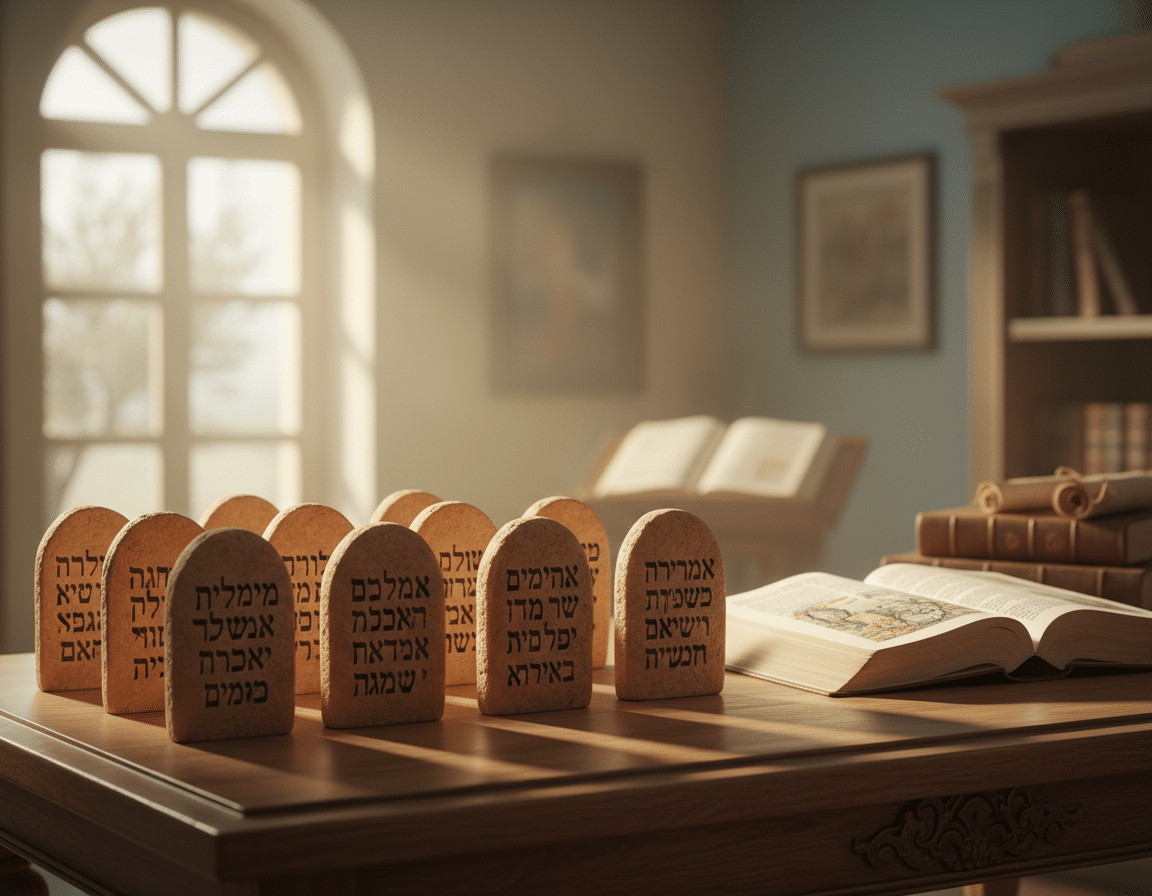

I often ask, can a simple plan help you recall God’s laws when it matters most?
I have seen many believers struggle to name this list in order under pressure. Dr. Craig Glickman notes that pastors and laypeople alike sometimes cannot. I will explain why learning these words helps me grow in faith and speak Scripture with confidence.
My goal: we will recall each commandment in the right order without a prompt. We will use a short keyword for each command to save time and lower stress.
We will practice with Exodus 20:3-17 and use three simple tools: word association, a number pattern, and a letter cue. This small plan helps the mind remember patterns better than a loose list.
As we learn, recall will shape choices that honor God and protect our neighbor. I keep hope in God’s word and trust that steady practice will change our lives.
Key Takeaways
- Learning Scripture builds clarity, faith, and confidence.
- A brief plan beats a scattered list under pressure.
- We will use Exodus 20:3-17 as our source text.
- Three tools—association, number pattern, letter cues—make recall easy.
- Recall helps daily choices that reflect God’s truth and hope.
Memorizing the Ten Commandments with simple memory tools
A simple pattern and a picture will help you hold each command in order.
Set one clear goal: I will recite each commandment in order without help, at a steady pace.
Pick a practice schedule that fits real life. I recommend two short sessions each day so your plan respects family and work time.

Use word association
Choose one strong image for each commandment. A stop sign works for a “do not” command. A calendar icon fits a Sabbath day.
Practice out loud
Speak each commandment and then check Exodus 20:3-17 to keep accuracy. Adults learn well with active recall.
Adjust cues that fail
Track weak points. Change one cue at a time until the commandment stays firm in your memory. Repeat hearing and speaking until it feels natural.
- Set a single, measurable goal for order and pace.
- Practice twice a day to save time and build habit.
- Use clear images to lock memory in place.
- Read Exodus 20:3-17 after each round to verify words.
Use a pattern that locks in the commandments order
I use a simple numeric map to fix each command in its proper place. This frame cuts ten items into three memory chunks. It frees the mind to recall linked ideas instead of a long list.

Use the prime-number pattern as your map: two, three, five
Two holds the two “no” commands: gods and idols. Say: I worship God alone; I reject idols.
Group the next three as honor commands
Three covers God’s name, sabbath day, and honor father mother. These remind us to honor and remember God and family.
Group the final five as actions to avoid
Five lists actions in Exodus order: murder, adultery, steal, false witness, covet. Chunking speeds recall and steadies confidence.
Use the letter mnemonic: GIVSH MAST-C
Match each letter to one Exodus keyword: gods, idol, vain, sabbath, honor, murder, adultery, steal, testify falsely, covet. One short letter cue triggers one commandment.
| Group | Number | Focus | Letters |
|---|---|---|---|
| First | 2 | No other gods, no idols | GI |
| Second | 3 | God’s name, sabbath day, honor father mother | VSH |
| Third | 5 | Murder, adultery, steal, false witness, covet | MAST-C |
Write the pattern once, say it twice, then test recall. It saves time and builds steady faith in speech.
Attach a clear cue to each commandment
I give each command a single, vivid cue so you can speak them in order with calm confidence. Below I list one short image or phrase tied to Exodus 20:3-17. Use these cues in practice until recall becomes natural.
No other gods before God
Cue: a single throne. Say: I worship God alone. This ties to Exodus and keeps the first commandment firm.
No idols of any kind
Cue: a broken statue. Say: I reject idols. The image is clear and quick to call to mind.
Do not misuse God’s name
Cue: a sealed mouth. Say: I honor God’s name. Repeat the line aloud and link it to Scripture wording.
Remember the sabbath day and keep it holy
Cue: a calendar marked in red. Say: I keep the sabbath day holy. Use this to recall rest and worship.
Honor father and mother and remember the promise of long life
Cue: hands holding a family photo. Say: I honor father and mother and trust God’s promise of long life.
Do not murder — “six feet under”
Cue: a grave marker. Say: I do not murder. The phrase “six feet under” links the idea and helps recall order.
Do not commit adultery — loyalty
Cue: a wedding band. Say: I am loyal. Keep the focus on fidelity to remember this commandment.
Do not steal — a quick story cue
Cue: Aladdin stealing bread. Say: I do not steal. A short story image fixes the action in mind.
Do not bear false witness — false claim
Cue: a rumor headline like “Revolution 9.” Say: I do not bear false witness. This links lying testimony to real harm.
Do not covet your neighbor’s house or anything that belongs to your neighbor
Cue: a neighbor’s front door. Say: I do not covet my neighbor’s house or goods. Use this last image to close the sequence.
Study Exodus 20 after each run to keep accuracy and deepen understanding.
Conclusion
I choose one clear goal: I will recall the commandments in order and check my words against Scripture.
I will practice short recall sessions twice daily and repeat Exodus 20:3-17 once each week as a faith habit. This plan fits a normal day and grows steady hope.
I trust love for Christ and trust in God’s word more than self-effort. Luke 10:27 sums our aim: love God and love neighbor, which is the true outcome of learning commands.
Teach this list to family in a simple way and adapt cues that fail. For help with rest and worship habit see why sabbath keeping matters. I will choose one way, practice it, and adjust cues until recall stays firm.