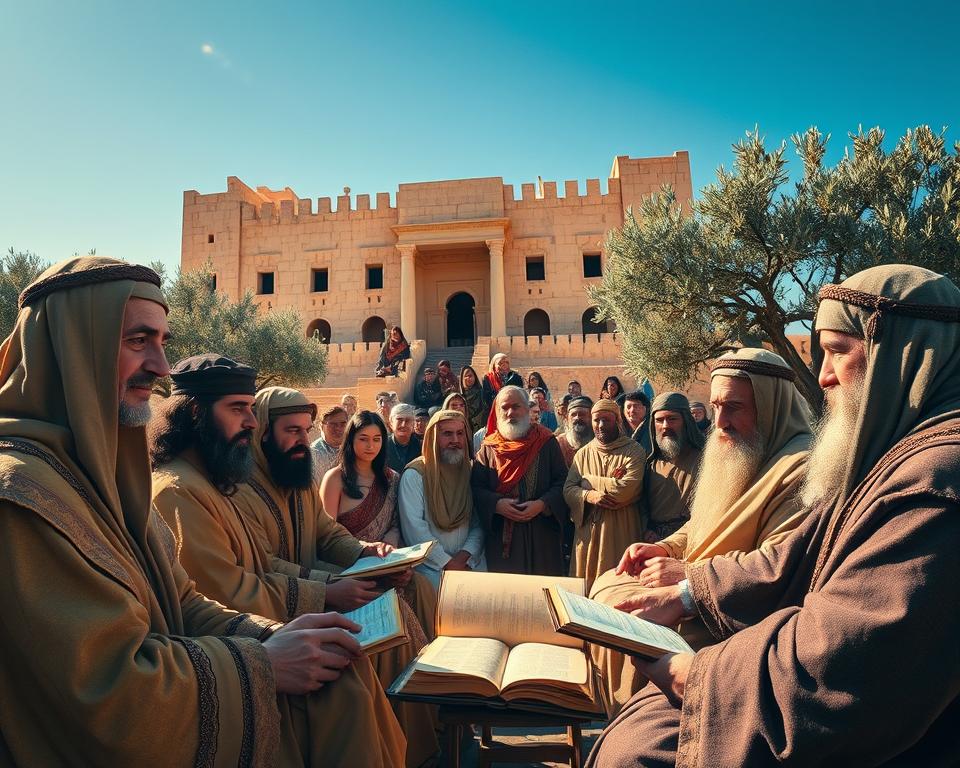

I invite you to walk with me through the Old Testament prophecies about Messiah, and to listen as Scripture itself points to a single, unfolding plan for the world and for our hearts.
Luke 24 shows Jesus opening the Scriptures so that disciples understand how Moses and the prophets speak of him. I want us to read those passages slowly, noticing how the book, the prophets, and the Law form a steady thread.
My aim is simple: we will study what the messiah would do—his birth, ministry, suffering, death, resurrection, and reign—and see how the New Testament cites these promises as fulfillment.
I will mention the Stoner illustration to show how remarkable the timing and pieces feel, while reminding you that faith rests on God’s truth and not on math alone.
Key Takeaways
- We study Scripture to see how the prophets point to one coming Redeemer.
- Luke 24 models how Jesus linked Moses and the prophets to his life and mission.
- The New Testament reads many Hebrew passages as fulfillment in Jesus.
- Our goal is faith and hope rooted in God’s word, not only in probabilities.
- Follow the path: birth, ministry, rejection, suffering, resurrection, and reign.
- Expect both light and struggle; the rejected stone becomes central at the end.
Guide overview: scope, sources, and why prophecy matters
Here I set the scope and sources so you can trace how the messiah would appear in Scripture and how early witnesses report fulfillment.
Scope: I focus on what the messiah would be and do as revealed in the Torah, the Prophets, and the Writings. We read Genesis through Malachi for the promises and the New Testament for how first-century witnesses report fulfillment.

User intent: understand, see fulfillment, enrich faith
I write so people can understand claims, follow clear steps, and test each citation. The New Testament quotes Hebrew texts often: Mark has 27 direct quotations, Matthew 54, Luke 24, and John 14. These data show how the early church read Scripture as fulfillment.
Method and why it matters
My method is simple. I present each prophecy with its reference and note how the new testament reads it in the life and ministry of Jesus. This matters because prophecy anchors faith and reveals God’s way in history.
How the New Testament reads the Hebrew Scriptures
The way the New Testament cites Hebrew texts mixes direct prediction and deeper reading.
Prediction means a prophet says what the messiah would do or be. When an event occurs, the New Testament points to that text as proof of fulfillment. This is one clear way apostles argue for truth.
Pattern points to types in Israel’s history. The book of Israel shows scenes and people that foreshadow later work. The new testament then presents Jesus as the one who completes those patterns.
Figural reading and sensus plenior
Figural reading says earlier acts foreshadow later realities. A later event makes the first act mean more.
Sensus plenior explains how Scripture can hold a fuller sense than its human author saw. God can reveal a deeper meaning later without denying the original context.

“Behold, the young woman shall bear a son” — Matthew 1:23 (using the Greek reading).
| Method | What it shows | Example |
|---|---|---|
| Prediction | Direct claim about future | Prophet speaks; event fulfills |
| Pattern/Type | Earlier story points ahead | Israel’s life echoes in Jesus’ life |
| Figural / Sensus plenior | Fuller meaning later revealed | Matthew cites Isaiah 7:14 (Greek) |
Scholars debate methods and limits. I invite you to test each claim by the book itself and see how apostles walk the way of God’s word toward fulfillment jesus. Trust that the same God guides man and woman in faith as they read and obey.
Birth prophecies: lineage, place, and sign
Scripture gives clear markers for the promised son: family line, hometown, and a visible sign to the people.
Lineage: God promises the blessing through Abraham, Isaac, and Jacob. He ties the royal line to Judah and to David’s house (see Genesis 12:3; 17:19; 28:14; 49:10; 2 Samuel 7). This shows where the messiah would come from and why his name matters in God’s plan.
Born in Bethlehem and called out of Egypt
Micah 5:2 points to Bethlehem as the ruler’s birthplace, and Matthew 2 cites that text when Jesus is born in David’s city. Hosea 11:1 speaks of a child called from Egypt in Israel’s history; Matthew applies that movement to the child who returns, showing a pattern the new testament reads as fulfillment jesus.
Isaiah 7:14 and the sign
Isaiah 7:14 uses the Hebrew word almah, a young woman; the Greek Septuagint reads parthenos, a virgin. Matthew quotes the Greek form and links the sign to God with us, Immanuel. The debate on timing and meaning remains, but the gospel writers present the sign as part of a chain that shows who the son is and why people should hope.
Old Testament prophecies about Messiah
Scripture presents four converging roles that describe who the promised one will be.
Core themes: king, servant, prophet, Son
King: The Davidic line and royal rule point to a ruler who reorders justice and peace (see 2 Samuel 7; Psalm 2).
Servant: Isaiah 53 shows a servant who bears suffering and brings healing for sins.
Prophet: Deuteronomy and later writings picture a mediator who speaks God’s truth to the people.
Son: Daniel 7 and the psalms speak of a Son who receives authority and restores life.
From promise to fulfillment: birth, ministry, death, resurrection
These themes form a path. The promised child would be born, begin a mission of mercy, face rejection and death, and be raised in vindication.
- The prophets and psalms prepare expectation; the new testament witnesses place Jesus in that line.
- Isaiah 61 and Psalm 16 frame ministry and life beyond death.
- Isaiah 53 explains how the servant bears sin so people find healing through his offering.
I present these threads so we see one plan at work: God keeps covenant, brings hope, and fulfills his word in the Son.
Ministry in light and power: Galilee and good news
When a voice cried in the wilderness, the way for the Lord began, and soon a great light shone in Galilee through Jesus’ ministry.
Light in Galilee and the wilderness way
Isaiah 9:1-2 celebrated light rising in Galilee. Matthew 4:12-17 cites that text as Jesus starts to preach and call people to repent and believe.
Isaiah 40:3 names the voice in the wilderness. John 1:23 applies that voice to John the Baptist who prepares the way.
Spirit‑anointed ministry to the poor and broken
Jesus read Isaiah 61:1-2 in a synagogue and announced that the Scripture was fulfilled in his name. Luke records him declaring good news to the poor and liberty for the oppressed.
Isaiah 35 and 42 describe healing, sight for the blind, and gentle justice. The Gospels report these works as signs that the son brings life and light to people.
“The Spirit of the Lord is upon me…”
| Isaiah passage | Promise | Gospel reference |
|---|---|---|
| Isaiah 9:1-2 | Light in Galilee | Matthew 4:12-17 |
| Isaiah 40:3 | Voice in the wilderness (way) | John 1:23 |
| Isaiah 61:1-2 | Good news to the poor; anointed ministry | Luke 4:16-21 |
| Isaiah 35 / 42 | Healing and gentle justice | Reported in Gospel healings and teaching |
In short: the way began in the wilderness, light broke in Galilee, and the ministry showed God’s heart for the broken. I see these links as clear markers of fulfillment jesus and as an invitation for people to follow the way in time and life.
The Prophet like Moses: mediator and message
In Deuteronomy Moses promises a future mediator who will speak God’s word to the people.
Context: Moses warns Israel to reject false speakers and then pledges that God will raise up a faithful prophet from among the people. Deuteronomy 18:15–19 frames that figure as one who will relay God’s commands plainly and demand a hearing.
How the Gospels and Acts apply the promise
Crowds in John call Jesus “the Prophet” (John 6:14; 7:40), echoing Moses’ promise. In Acts Peter cites Deuteronomy 18 and calls Jesus the one God raised up (Acts 3:22). Stephen likewise points to that same book when he names Jesus the prophet God foretold (Acts 7:37).
The course of evidence shows that the new testament reads this pledge as clear fulfillment. The one Moses foreshadowed teaches with authority, works signs as proof, and calls people to obedience.
“Hear him,” Moses warned—God will require a hearing for the prophet like him.
I urge you to listen. The prophet serves as the faithful son who brings life through the word the Father gave him.
The forerunner: Elijah and the messenger
Malachi holds two linked promises: a preparatory messenger and the coming of Elijah before the great day.
Malachi 3:1 names a messenger who will prepare the way. Malachi 4:5–6 promises Elijah will come to turn hearts before the day of the Lord.
How the New Testament links the promise
The new testament applies these texts to John the Baptist. Luke 1:16–17 says John comes in the spirit and power of Elijah to turn fathers to children and the disobedient to wisdom.
Jesus affirms that Elijah has come in John (Matthew 11:10; 17:9–13; Mark 9:11–13). John’s calling echoes Isaiah 40:3, the voice in the wilderness that clears the way.
“Prepare the way of the Lord” — applied to the one who calls people to repentance and obedience.
In short: the forerunner clears obstacles so the son can fulfill his work. John points people back to God’s word and mercy. Others in the new testament testify that God kept his promise in their day.
| Passage | Promise | New Testament link |
|---|---|---|
| Malachi 3:1 | Messenger prepares the way | Matthew 11:10; Mark 1:2 |
| Malachi 4:5–6 | Elijah turns hearts before the day | Matthew 17:10–13; Luke 1:16–17 |
| Isaiah 40:3 | Voice cries in the wilderness | John 1:23; Matthew 3:3 |
The rejected cornerstone and the stumbling stone
Some texts place rejection and honor side by side. Psalm 118:22–24 calls the stone the builders cast off the very one the Lord makes a cornerstone.
Jesus cites that image in a parable, and the book of Acts repeats it when Peter says no salvation apart from that stone (Acts 4:11–12). The new testament frames the event as both judgment and rescue.
Isaiah texts in apostolic teaching
Isaiah 28:16 names a precious cornerstone the Lord lays. Isaiah 8:14 speaks of a stone that makes some stumble.
1 Peter 2 joins these lines to show the son is both sure foundation and a test for those who refuse God’s word.
“The stone the builders rejected has become the cornerstone.”
In short: people either trust the cornerstone or trip over him. Scripture teaches that God uses rejection to bring about his plan. My appeal is simple: embrace faith in the one Scripture sets as foundation and see how fulfillment jesus meets the promise.
Suffering and substitution: Isaiah 52:13-53:12
Isaiah 52:13–53:12 frames a suffering servant who bears the burden of many and points us to God’s plan of rescue.
The servant’s pain: the text says he is pierced, crushed, and afflicted. He takes on our sins and endures shame. His suffering is described as substitutionary; he pours out his life and blood unto death.
The New Testament witness
The new testament reads these lines as explaining Jesus’ healings, his ransom, and the cup of covenant (see Matthew 8:16–17; Mark 10:45; Luke 22:20).
Philip uses Isaiah 53 when he meets the Ethiopian and proclaims the fulfillment jesus (Acts 8:32–35). Other writers name him as the one who bore transgression and brought life (1 Peter 2; Hebrews 9).
Vindication and hope
Isaiah also promises vindication: the servant will see his seed, prolong his days, and be exalted. God joins the cross and the crown.
In short: the messiah would both suffer and reign. One head of the promise is substitution for sins; the other is life beyond the end. I urge you to trust the servant God raises and receive the peace he gives.
Psalm 22 and the pierced righteous sufferer
Psalm 22 voices a raw lament that moves toward a confident song of deliverance.
Forsaken cry: The psalm begins, “My God, my God, why have you forsaken me?” This cry appears in the Gospels on the cross (Matthew 27:46; Mark 15:34). It frames suffering as genuine abandonment yet rooted in faith.
Mockery, piercing, lots, and vindication
The text names mockers and the casting of lots for clothing. The New Testament records soldiers casting lots (John 19:23–24) and crowds jeering (Matthew 27:39, 43–44).
Pierced language in the psalm and the Gospel scene links the righteous sufferer to a trial that leads to death and then to vindication.
“I will tell of your name to my people; in the assembly I will praise you.”
| Psalm line | New Testament echo | Theological note |
|---|---|---|
| Forsaken cry (22:1) | Matthew 27:46; Mark 15:34 | Shows felt abandonment within trust |
| They cast lots for my clothing (22:18) | John 19:23–24 | Fulfills detail and highlights witness accuracy |
| From lament to praise (22:22–31) | Hebrews 2:11–12; Acts echoes | Son declared among the children; public worship follows |
In short, the psalm shapes how I read suffering and hope. The righteous sufferer enters death, yet morning comes. The pattern joins Isaiah 53 and Psalm 16, so the one who endures rises and spreads light to the nations in fulfillment.
Timeline and fulfillment: Daniel’s weeks and the appointed time
Daniel 9:24–27 gives a compact vision that names goals: atonement, righteousness, and an end to sin. The text speaks in “weeks” and sets an appointed plan for handling guilt, sealing vision, and anointing a prophet.
Daniel 9:24–27 and views on timing and end
Many scholars read the passage in a Maccabean frame, linking the vision to Onias III and Antiochus IV. That view sees the seventy weeks as symbolic of the age then closing.
Christian readers also see the lines as forecasting that the messiah would be “cut off” and that the city and sanctuary would meet destruction. Jesus himself spoke of desolation in the holy place, and history recorded Jerusalem’s fall in AD 70.
Galatians 4:4 and the fullness of time
Paul writes that the Son came in the “fullness of time.” I take this to mean God set the right time for incarnation, death, and resurrection so the plan moves from promise to fulfillment.
- Key ends: deal with sin, bring righteousness, seal the prophetic witness.
- The new testament reads Daniel as part of that larger story.
- Our hope looks to the future and trusts God’s appointed time.
“But when the fullness of time had come, God sent forth his Son…”
In short, whether one reads Daniel as near‑term vision or as long‑range prophecy, the text directs us to God’s purpose: the messiah would face death and rise, the city would suffer judgment, and God’s saving age presses toward its promised end. Hold to Scripture, and keep faith in the hope it sets before us.
Kingly identity: Son of David, Lord of David, and Son of Man
I present 2 Samuel 7 as God’s covenant with David. In that promise a son will sit on David’s throne and his house will endure.
Psalm 110 then adds a striking twist: David calls his descendant “my Lord.” Jesus uses this passage to challenge hearing ears and to show the king’s unique name.
2 Samuel 7 and Psalm 110 in Gospel debate and Acts
Key point: the psalm places rulership and lordship together. Peter quotes Psalm 110 in Acts 2 to declare that God has made Jesus both Lord and king.
“The Lord said to my Lord: Sit at my right hand…”
Daniel 7:13-14 and the Son of Man in Jesus’ words
Daniel’s vision shows one like a son of man given agency, authority, and an everlasting kingdom. The figure receives universal rule and an unending end to enemies.
Jesus calls himself the Son of Man. That self‑title links his mission to Daniel’s vision and to the promise that the king’s rule brings life and final restoration.
| Text | Promise | New Testament use |
|---|---|---|
| 2 Samuel 7 | Davidic covenant: a son on the throne | Seen as foundation for royal line of the king |
| Psalm 110 | David calls his descendant “Lord” | Quoted by Jesus; used by Peter (Acts 2) to name Jesus Lord and king |
| Daniel 7:13–14 | One like a son of man given dominion | Jesus’ title “Son of Man” ties him to this vision |
In short: Scripture shows the promised king as both Son of David and Lord of David. This combined identity gives his name authority. It also teaches that the messiah would rule with power, bring life to those who call, and fulfill what the Father set in motion long ago.
Specific signs: donkey, thirty pieces of silver, acclaim
The Gospels point to clear public markers that the messiah would arrive humbly and be known by the people.
Zechariah 9:9 and the humble entry
The prophet pictures a king riding a donkey. Matthew records Jesus’ entry into the city on a colt. Crowds cry out and lay cloaks in the road. The scene shows a ruler who comes low and wins hearts.
Zechariah 11:12–13 and thirty pieces of silver
Another text names a price: thirty pieces silver. The new testament reports Judas’ agreement for that sum and the later return of the coins. The payment marks betrayal and fulfills a striking detail from the prophet.
Psalm 118 and public praise
People shout, “Blessed is he who comes in the name of the Lord.” That cry accompanies the entry and ties praise to the king’s name. The psalm also pictures a rejected stone that becomes the head of the corner.
“Blessed is he who comes in the name of the Lord.”
| Sign | Prophetic text | New Testament link |
|---|---|---|
| Humble entry on a donkey | Zechariah 9:9 | Matthew 21 |
| Thirty pieces silver | Zechariah 11:12–13 | Matthew 26–27 |
| Public acclaim and stone image | Psalm 118:25–29 | Matthew 21; Gospel crowd praise |
In brief: these signs link a humble king, a price of betrayal, and the people’s acclamation. The new testament records them as part of a larger pattern of fulfillment. I present them so you see how Scripture names the one who comes and the name that saves.
Passover, lamb, and atonement
In the Passover scene we meet the image of a spotless lamb whose blood marks the door and secures life for a household. This rite sets a pattern the Scriptures hold together from Exodus to the Gospels.
Exodus 12 and the lamb without defect
Exodus 12 requires a lamb without defect and blood on the posts so death passes over the people. The detail points to substitutionary rescue that God commands and makes sacred.
Servant, blood, and the new covenant
Isaiah 53 shows the servant who bears guilt and pours out life for many. The cup of the covenant and the cross join that image to the meal Jesus shared.
- Exodus 12: God saves Israel through a spotless lamb and marked doors.
- New testament echoes:
- John calls Jesus the Lamb of God; Paul names Christ our Passover; Peter notes the lamb’s precious blood.
- The servant in Isaiah bears sins and gives his life; his death makes atonement.
- This is one part of a single plan: the messiah would open the way by sacrifice and blood.
“Behold the Lamb of God…”
I urge you to see the continuity: from Exodus’ lamb to the Last Supper, fulfillment jesus stands at the heart of atonement and invites us to walk in faith with God’s word.
Resurrection and new covenant reality
We consider Psalm 16 and Jeremiah 31 as two parts of the same promise: life and a living covenant. I read both texts as joining to show how God raises and renews his people through the Son.
Psalm 16 and Acts on resurrection
Psalm 16:8–11 says the Holy One would not see decay. I read this as a promise that God would not abandon his chosen one to the grave.
Paul in Acts 13 cites that same hope. He contrasts David, who died, with the risen Son who did not see decay. This link makes the psalm a key part of the claim for resurrection.
Jeremiah and the cup of the covenant
Jeremiah 31:31–34 promises a new covenant written on the heart and sins forgiven. The Gospels and letters pick up that promise.
The Lord’s words at the Last Supper—”this cup is the new covenant in my blood”—connect the risen life and the meal. Luke 22:20 and 1 Corinthians 11:25 cite the cup as the living link to the promise. Hebrews unfolds how the covenant brings true forgiveness and enduring life for God’s children.
“I read Psalm 16 as a promise that God would not abandon his Holy One to the grave.”
| Passage | Promise | New Testament use |
|---|---|---|
| Psalm 16:8–11 | Holy One will not see decay; vindication | Acts 13:35–37 cites it for the resurrection |
| Jeremiah 31:31–34 | New covenant written on the heart; sins forgiven | Luke 22:20; 1 Corinthians 11:25; Hebrews 8–10 |
| Last Supper cup | Sign of the new covenant in blood; living bond | Celebrated in Gospel meals and early church practice |
In short: I affirm that the messiah would rise, that resurrection brings new life, and that the risen Son inaugurates a covenant that makes us God’s children by grace. This hope is a clear part of Scripture’s witness and of the new testament claim of fulfillment.
Scholarly dialogue: Jewish, Christian, and critical views
I begin with a simple premise: readers bring methods and history that shape how they read sacred texts. Scholars, rabbis, and church teachers often disagree because they ask different questions and use different tools.
Jewish scholars typically read the prophets in their original literary and historical context. Many conclude that several passages do not predict later events and so do not accept Christian fulfillment claims.
Critical historians analyze language, dating, and context. They note that some texts, such as Daniel 9, fit well with a Maccabean horizon. Others argue Matthew cites the Greek text of isaiah 7:14 (parthenos) while the Hebrew almah more naturally means a young woman. These differences shape conclusions.
Christian readers answer differently. The new testament writers use figural reading and sensus plenior to read the book with a fuller sense. They see patterns — Israel’s movement, the servant’s suffering, and symbolic acts like thirty pieces silver — as meaningful foreshadowing and fulfillment.
“People assign meaning by their method; weigh the arguments with care and read both the prophets and the New Testament closely in God’s presence.”
| Perspective | Method | Typical conclusion |
|---|---|---|
| Jewish | Contextual, historical-linguistic | Many texts read in original context; not seen as fulfilled in Jesus |
| Critical scholars | Historical criticism; dating and source analysis | Some passages align with later events (Maccabean); cautious on prediction |
| Christian | Figural reading; sensus plenior; intertextual use | New Testament citations show fulfillment; patterns point to a unified plan |
In practice, debate centers on translation choices, original referents (for example, Hosea 11:1 refers to Israel in its own book), and how readers assign meaning. I encourage careful study, charitable listening, and testing claims by Scripture and reason. For an extended guide to how the new testament cites fulfillment claims, see this helpful resource: prophecies fulfilled in the New Testament.
Conclusion
Let us stand where promise meets event and read the story Scripture unfolds in the Son. I close by pointing to Luke 24: the Law, the Prophets, and the Writings lead us to the one God sent and show how the messiah would bring a single saving way.
We see the rejected stone become the head of the corner, the servant who bears sin, the blood of the covenant, and the Father who raises his Son. Psalm 16 and Acts declare vindication; Jeremiah and the new testament promise a living covenant.
I call you to trust the new testament witness, follow as disciples, and teach your children these truths. May the Spirit fill you with light and hope as you wait for the future. I close with confidence: the end belongs to God, and fulfillment jesus gives life by grace.