Jesus is called the Son of God because he is God's own Son by nature, the eternal Son who shares everything the Father is. The title also marks him as the promised Messiah, the King God swore to give David. It names the one person who shows you the Father without distortion. It does not mean God made him, and it does not rank him below the Father. That is the plain reading, and you can check every piece of it in the text.
Why is Jesus called the Son of God?
He shares the Father's nature, the way any son shares his father's. In the Bible's way of speaking, being someone's "son" means carrying their likeness. For example, Acts 4:36 says the apostles nicknamed a man Barnabas, which means "son of encouragement." Nobody thought encouragement gave birth to him. The name told you what he was like.
So when Jesus called God his own Father, his listeners heard the claim clearly. John 5:18 says they tried all the harder to kill him, because he was "making himself equal with God." They understood him better than many readers do today.
Your place in God's family works differently. John 1:12 says those who receive Christ are given the right to become children of God. Galatians 4:4-5 says God sent his Son "so that we might receive adoption as sons." Jesus is the Son by nature, and we are sons and daughters by adoption, brought into a family that was always his.
That difference is good news for your week. The one who owns the house is the same one who signed your adoption papers. Romans 8:15 says you received the Spirit of adoption, so you can call God "Abba, Father" with no fear in your voice.
Read the key passages in context
Don't take the title on my word. Read the verses on either side of each passage below, because the setting carries half the meaning.
| Passage | Who speaks | What the text says |
|---|---|---|
| Mark 1:9-11 | The Father, from heaven | "Thou art my beloved Son; with thee I am well pleased" |
| Matthew 16:13-17 | Peter | "You are the Christ, the Son of the living God" |
| Matthew 17:1-5 | The Father, on the mountain | "This is my beloved Son… listen to him" |
| Mark 14:61-64 | Jesus, at his trial | Answers "I am" to "the Son of the Blessed" |
| John 20:30-31 | John, the writer | Tells you why the whole book exists |
At the Jordan
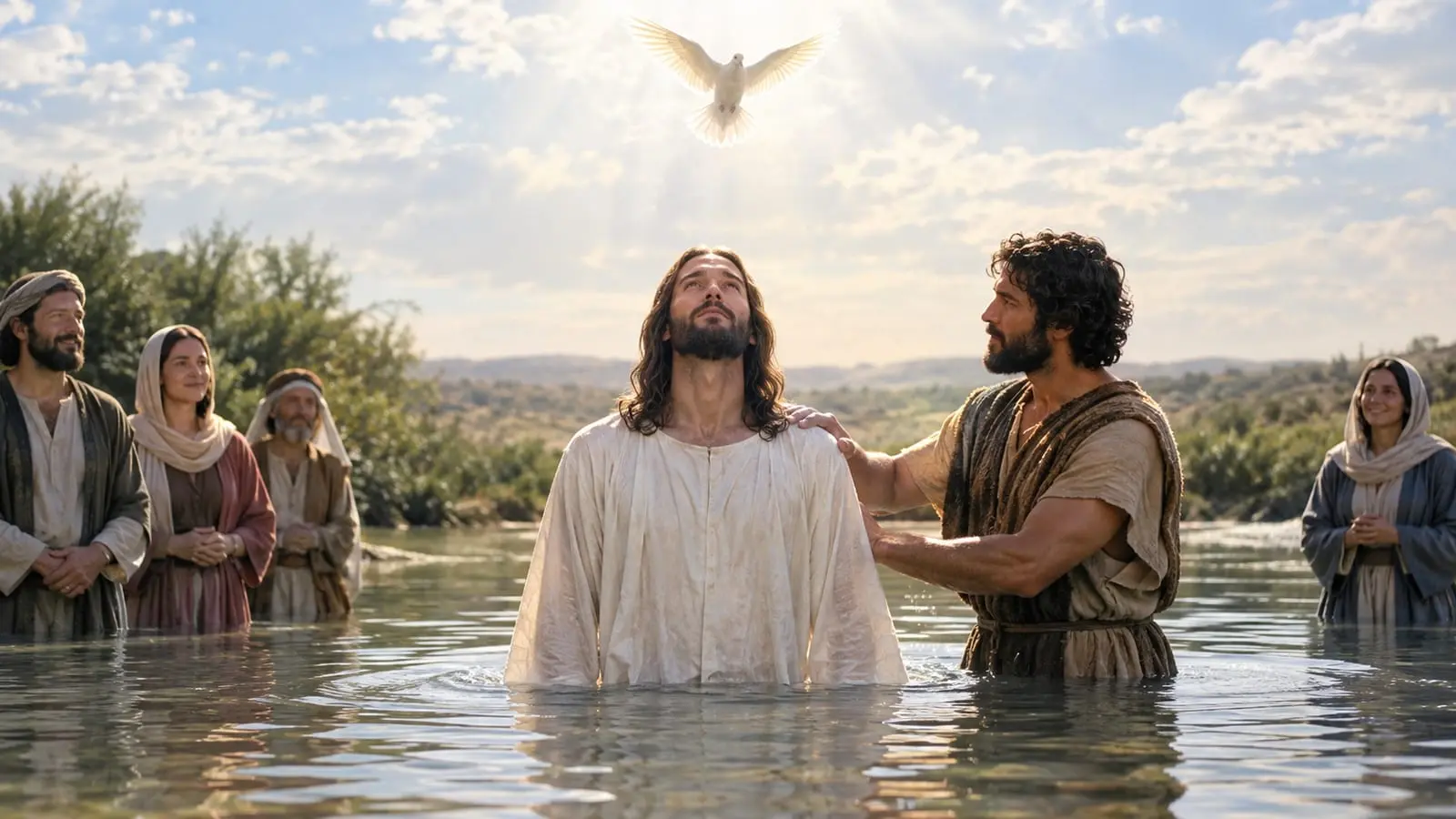
Start at the baptism. In Mark 1:11, after Jesus comes up out of the water, a voice comes from heaven: "Thou art my beloved Son; with thee I am well pleased." Meanwhile the Spirit comes down like a dove. Father, Son, and Spirit all appear in the same scene, and the Father is the one who names the Son.
At Caesarea Philippi
Then read Matthew 16. Jesus asks who people say he is, and the crowd's answers fall short: a prophet, John the Baptist come back. Simon Peter replies, "You are the Christ, the Son of the living God." Jesus says no human taught Peter that. The Father revealed it.
At the trial
Mark 14 is the hardest scene to explain away. The high priest asks if Jesus is "the Son of the Blessed." Jesus says "I am," then adds that they will see him seated at God's right hand and coming with the clouds. As a result, the high priest tears his robes and calls it blasphemy.
Claiming to be the Messiah was not, by itself, a death sentence. Claiming to share God's throne was.
John's reason for writing
John tells you plainly why he wrote his Gospel. In John 20:31 he says, "but these are written that you may believe that Jesus is the Christ, the Son of God, and that believing you may have life in his name." Every miracle in that book is aimed at that sentence.
What does "only begotten Son" mean?
It means one of a kind. The phrase comes from John 3:16 in the King James Version, and the Greek word behind it, monogenes, describes something unique in its class. Newer translations render it "one and only Son" or "only Son," and they get the sense right.
Here is the verse that settles it. Hebrews 11:17 calls Isaac Abraham's monogenes son. Yet Abraham also had Ishmael. Isaac was not his only child. He was the unique son, the son of the promise.
So "only begotten" tells you Jesus is the Son in a way nobody else is. It says nothing about a moment when he came into being. John 1:1-3 rules that out: "In the beginning was the Word," and "all things were made through him." Whoever made all things was not among the things made.
The strongest objection
That is a fair question: if he is a son, didn't he have a beginning? After all, human fathers exist before their sons.
The answer is that the Bible uses "son" for sameness of nature, not for a place in line. A son of a carpenter's line is a carpenter, and the Son of God is God. Furthermore, Jesus prays in John 17:5 for the glory he had with the Father "before the world existed."
Colossians 1:15 raises the same worry when it calls him the "firstborn of all creation." However, the very next verse says all things were created through him. In Scripture, "firstborn" can name the heir's rank. Psalm 89:27 gives that title to David, the youngest son in his family.
Luke 1:35 adds a different layer. There the angel tells Mary that her child will be called the Son of God because the Holy Spirit will come upon her. Luke is explaining why the human baby carries the title. He is not saying the Son started there.
The Son claims what belongs only to God
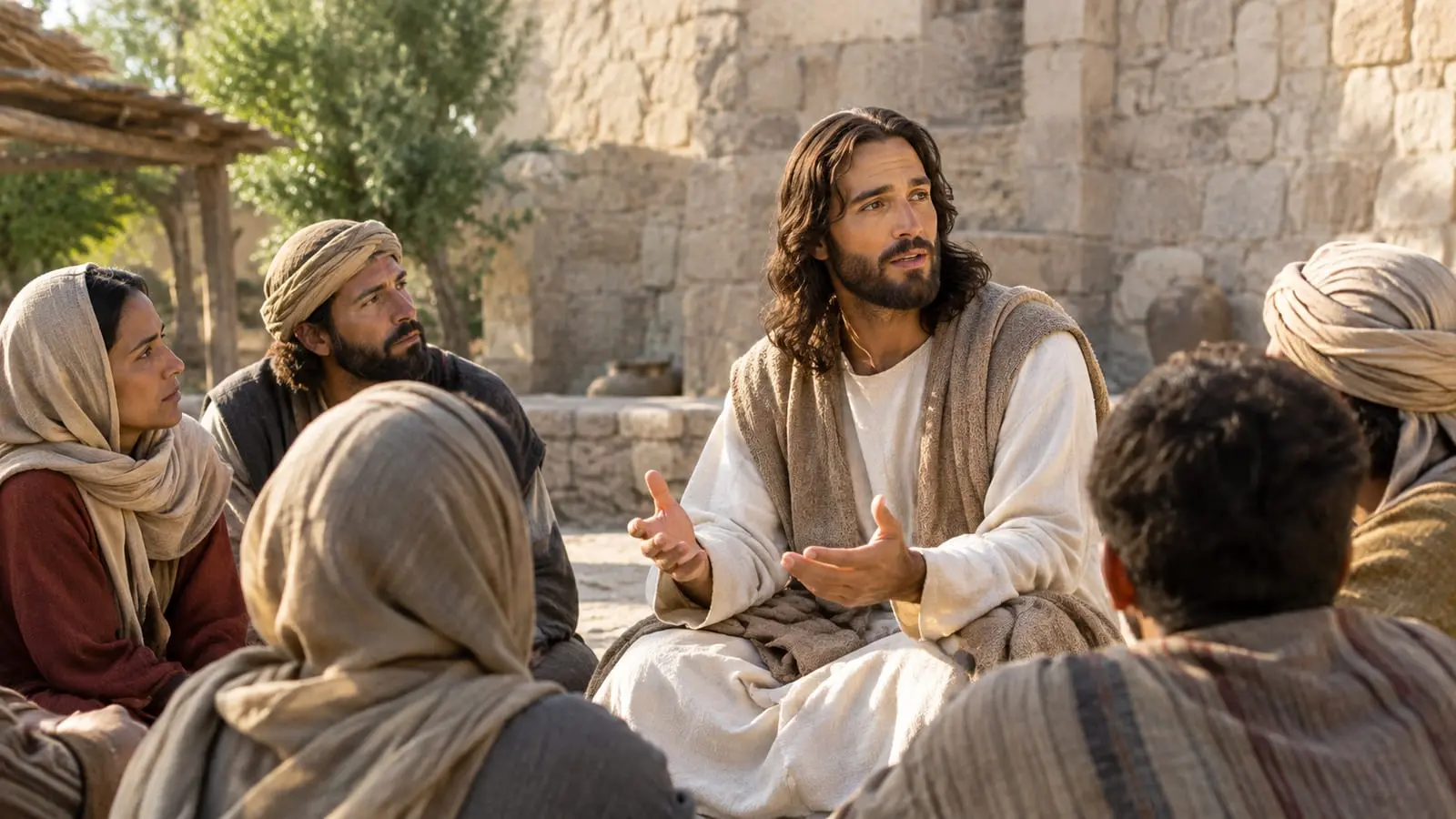
Jesus did things that only God has the right to do, and the people around him noticed. In Mark 2:5-7 he tells a paralyzed man his sins are forgiven. The scribes object immediately: "Who can forgive sins but God alone?" They had the theology right. They missed who was standing in front of them.
His words went further still. In John 5:23 he says all should honor the Son "just as they honor the Father." In John 8:58 he says, "before Abraham was, I am," using the name God gave Moses at the burning bush. In John 10:30 he says, "I and the Father are one." Both times the crowd picked up stones.
Watch what he does with worship, too. When Thomas falls down in John 20:28 and says "My Lord and my God," Jesus accepts it. Compare Acts 10:25-26, where Peter pulls Cornelius to his feet, and Revelation 22:8-9, where an angel tells John to stop. Good creatures refuse worship. The Son receives it.
Hebrews 1:3 sums it up: the Son is "the exact imprint of his nature." Then Hebrews 1:8 has the Father address him directly: "Your throne, O God, is forever and ever."
Father and Son in the Trinity
The Son is fully God and still a distinct person from the Father. The word for this is the Trinity, the teaching that the one God exists as Father, Son, and Holy Spirit, each fully divine and each truly personal. John 1:1 holds both halves in a single line: "the Word was with God, and the Word was God."
"With God" means he is distinct. "Was God" means he is divine. Drop either phrase and you drift into a known wrong turn.
- Separate gods. Deuteronomy 6:4 says the Lord is one. Father and Son are not rival deities sharing a title.
- One person, different masks. Jesus prays to the Father in John 17. He is not talking to himself.
- A created Son. John 1:3 says nothing that was made was made without him.
The church has fought over this before. The First Council of Nicaea met in the city of Nicaea in 325 AD after a church leader named Arius taught that the Son was a created being. The council confessed the Son as being of the same substance as the Father.
Adventists don't take doctrine from councils, though. We take it from the text, and on this point the text and the council agree.
How the Father and Son are one God and still distinct persons, I do not know. Nobody does, and that should not worry you. Scripture tells you who God is, even where it does not explain how he is.
Why are angels and believers called sons of God?
They are sons by creation or by adoption, while Christ is the Son by nature. The phrase shows up in several places, and each use has its own reason.
| Who | Why the title fits | Here is the verse |
|---|---|---|
| Angels | Created by God, attending his throne | Job 1:6, Job 38:7 |
| Adam | Made directly by God | Luke 3:38 |
| Israel | Called and rescued as a nation | Hosea 11:1 |
| Believers | Adopted and led by the Spirit | Romans 8:14-15 |
| Jesus | Shares the Father's own nature | John 1:18, Hebrews 1:3 |
Hebrews 1 draws the line on purpose. Verse 5 asks, "To which of the angels did God ever say, 'You are my Son, today I have begotten you'?" The expected answer is none of them. Then verse 6 commands all God's angels to worship the Son.
So the title on a creature means "made by God" or "brought in by God." On Jesus, it means "of God." The words overlap, while the meanings sit far apart.
Son of David and Son of God
Jesus is both, and the Old Testament promised both. In 2 Samuel 7:12-14, God promises David an offspring whose throne will last forever, and adds, "I will be to him a father, and he shall be to me a son." Psalm 2:7 picks up the same line: "You are my Son." If you want to trace these threads further, read through the messianic prophecies in the Old Testament and the messianic prophecies in the Psalms.
Gabriel ties the promises together in Luke 1:32-33. Mary's son will be called "the Son of the Most High," and God will give him "the throne of his father David." Paul says the same in Romans 1:3-4. Jesus was descended from David by human birth. He was declared the Son of God in power by his resurrection from the dead.
Jesus himself raised the puzzle in Matthew 22:41-46. If the Messiah is David's son, why does David call him "Lord" in Psalm 110:1? Nobody could answer him.
The answer is Bethlehem. David's son by birth is David's Lord by nature. One Savior carries both titles, because he had to be fully human to die in our place and fully God for that death to save.
Where the text ends and the Adventist reading begins
Here is what the text says, without any denominational help. The Son is God (John 1:1, John 20:28). He existed before creation and made it (John 1:3, John 17:5). He is distinct from the Father (John 17). He became human and was raised from the dead (Romans 1:3-4).
Here is how Adventists read it. The church's statement of belief about God the Son confesses him as eternal and truly God, one with the Father and the Spirit in the Godhead. Adventist teaching then puts heavy weight on what the Son is doing now. Hebrews 8:1-2 says he serves as our high priest in the sanctuary in heaven, and Adventists hold that his work there continues.
Honesty requires one more note. Some early Adventist leaders taught that the Son had a beginning. The church moved away from that view as it studied the Scriptures more closely. Ellen White wrote of Christ, "In Christ is life, original, unborrowed, underived," and the church's settled position matches the biblical one.
That history should make you more careful, not less trusting. Even sincere believers can read a title wrong. So check it for yourself, the way Acts 17:11 says the Bereans did.
What to do before next Sabbath
Confess him, and then live like the confession is true. Romans 10:9 ties salvation to confessing with your mouth that Jesus is Lord. The Father's own command in Matthew 17:5 was short: "listen to him." Because a Son with that much authority deserves more than agreement, John 14:15 makes the link: if you love me, keep my commandments.
Here is a plan for this week:
- Friday evening, after sundown, read John 5 aloud at the table.
- Mark every place Jesus claims what only God can do.
- Read Matthew 16:13-17 and answer Jesus' question in your own words.
- Pray Peter's sentence back to God: "You are the Christ, the Son of the living God."
- Name one command of his you have treated as optional, and keep it this week.
You are not earning your place by doing this. That place came by grace, and obedience follows after. You are simply taking the Son at his word.
For more on what Jesus did with his years among us, see these truths about Jesus' life on earth.
FAQ
Did Jesus ever call himself the Son of God?
Yes. In John 10:36 he asks his critics why they accuse him of blasphemy "because I said, 'I am the Son of God.'" His favorite title for himself, however, was "Son of Man," borrowed from Daniel 7:13-14. That figure comes on the clouds and receives a kingdom that never ends, so it is a heavenly claim too.
Why does Jesus say "the Father is greater than I"?
In John 14:28 he is speaking as the one sent, who had taken a servant's place. Philippians 2:6-8 says he did not cling to equality with God but humbled himself and became obedient to death. The rank describes the mission he accepted. His nature never changed, and the same Gospel opens by calling him God.
Do Adventists believe Jesus is Michael the archangel?
Adventists identify Michael with Christ, drawing on Daniel 12:1, Jude 9, and 1 Thessalonians 4:16. In that reading, "archangel" is a title of rank meaning ruler of the angels, and it does not make him a created being. Many other Christians disagree with this view. It is an Adventist conclusion from the text, and it never lowers the Son's full deity.
Who are the "sons of God" in Genesis 6?
Genesis 6:2 does not say, so readers have to decide from the surrounding chapters. Many Adventists read it as the faithful line of Seth marrying outside the faith. Others think it means angels, but Jesus says in Matthew 22:30 that angels do not marry. Wherever you land, the passage has nothing to do with Christ's unique sonship.