

Ask God plainly for healing, then leave the outcome in his hands. Christian prayers for healing can ask for physical recovery, a steady mind, forgiven sin, and strength to endure. However, Scripture does not let us turn prayer into a guarantee. We ask in Jesus’ name, receive proper care, and trust the resurrection promised in 1 Corinthians 15:42-44.
What are Christian prayers for healing?
Christian prayers for healing are requests made to God through Jesus Christ for mercy, restoration, strength, and peace. John 16:23 tells believers to ask the Father in Christ’s name. That means asking in line with his character and will, as 1 John 5:14 explains.
These prayers are for the sick, the frightened, the exhausted, and those who love them. They also belong in the church. James 5:14 tells the sick person to call the elders and receive prayer rather than carrying the need alone.
Use this plain pattern:
- Tell God exactly where you hurt, as Hezekiah did in 2 Kings 20:1-6.
- Ask directly for healing, as Bartimaeus did in Mark 10:51-52.
- Confess known sin and receive forgiveness according to 1 John 1:9.
- Place the outcome under God’s will, following Jesus in Luke 22:42.
- Ask for strength to obey while you wait, as Paul learned in 2 Corinthians 12:9.
Hezekiah’s prayer was specific. He wept bitterly and asked the Lord to remember how he had walked before him faithfully (2 Kings 20:3). God answered, though that passage does not promise every sick person the same result.
Prayer also belongs beside wise care. Isaiah 38:21 records a practical treatment for Hezekiah, and 1 Timothy 5:23 records Paul recommending a remedy to Timothy. Refusing care is not stronger faith.
How should you pray boldly without presuming on God?

Ask for the whole thing. Tell God you want the pain gone, the test clear, the treatment effective, and the body restored. Matthew 7:7 tells you to ask, while Hebrews 4:16 tells you to come boldly for mercy and grace.
Then surrender the answer. Jesus prayed in Gethsemane, “Not my will, but yours, be done” in Luke 22:42. That sentence was not weak faith. It was perfect trust under crushing sorrow.
The tension matters:
| Faithful prayer does this | Presumption does this |
|---|---|
| Asks clearly for healing | Announces that healing must happen |
| Trusts God’s character | Measures God by one desired outcome |
| Uses medicine and pastoral care | Treats care as a lack of faith |
| Waits without pretending | Claims symptoms are gone when they remain |
| Holds to the resurrection | Treats present recovery as the final hope |
Faith speaks honestly about both desire and pain. Psalm 13:1 asks, “How long?” and still ends in trust. God can bear a prayer with tears on it.
How can you pray for your own healing, strength, and peace?
A personal healing prayer should name your need without trying to impress God. Matthew 6:7-8 warns against empty repetition because the Father already knows what you need.
You can pray:
Father in heaven, you see my body, my thoughts, and the fear I have not said aloud. Please have mercy on me through Jesus Christ. Bring healing where it serves your wise will, guide those caring for me, and give me strength for today.
Forgive my sins according to 1 John 1:9. Quiet my mind with the peace promised in Philippians 4:6-7. Keep me from bitterness, panic, and false confidence.
If recovery comes slowly, help me endure. If the answer is different from what I want, hold me close. I place my life in your hands and wait for the complete restoration promised in Revelation 21:4. In Jesus’ name, amen.
You do not need polished words. Romans 8:26 says the Holy Spirit helps when weakness leaves you unable to express what is happening.
For more Scripture-shaped language, use these prayers for strength and direction as a starting place. Read each verse in context before making it your own prayer.
How can you pray for a loved one who is sick?
Intercessory prayer means bringing another person’s need before God. Mark 2:3-5 shows friends carrying a man to Jesus when he could not reach Christ on his own.
Pray with compassion and restraint. Do not announce what God will do. Do not make the sick person defend their faith while they are trying to get through the afternoon.
You can pray:
Lord Jesus, you know and love this person better than I do. Please ease their pain, strengthen their body, clear their mind, and guide every decision about their care.
Give wisdom to the people treating them, as James 1:5 promises wisdom to those who ask. Protect them from fear and loneliness. Let them know your presence, even when the room is quiet and the answer is slow.
We ask boldly for healing. Still, we place their life under your wise will. Keep our hope fixed on you rather than on one report or one result. In your name, amen.
After praying, do something useful. Bring food, handle an errand, sit quietly, or send a clear message that does not demand an answer. James 2:15-16 does not let warm words replace practical care.
For help praying with another person in mind, read this guide to intercessory prayer.
Why did Jesus heal the sick?
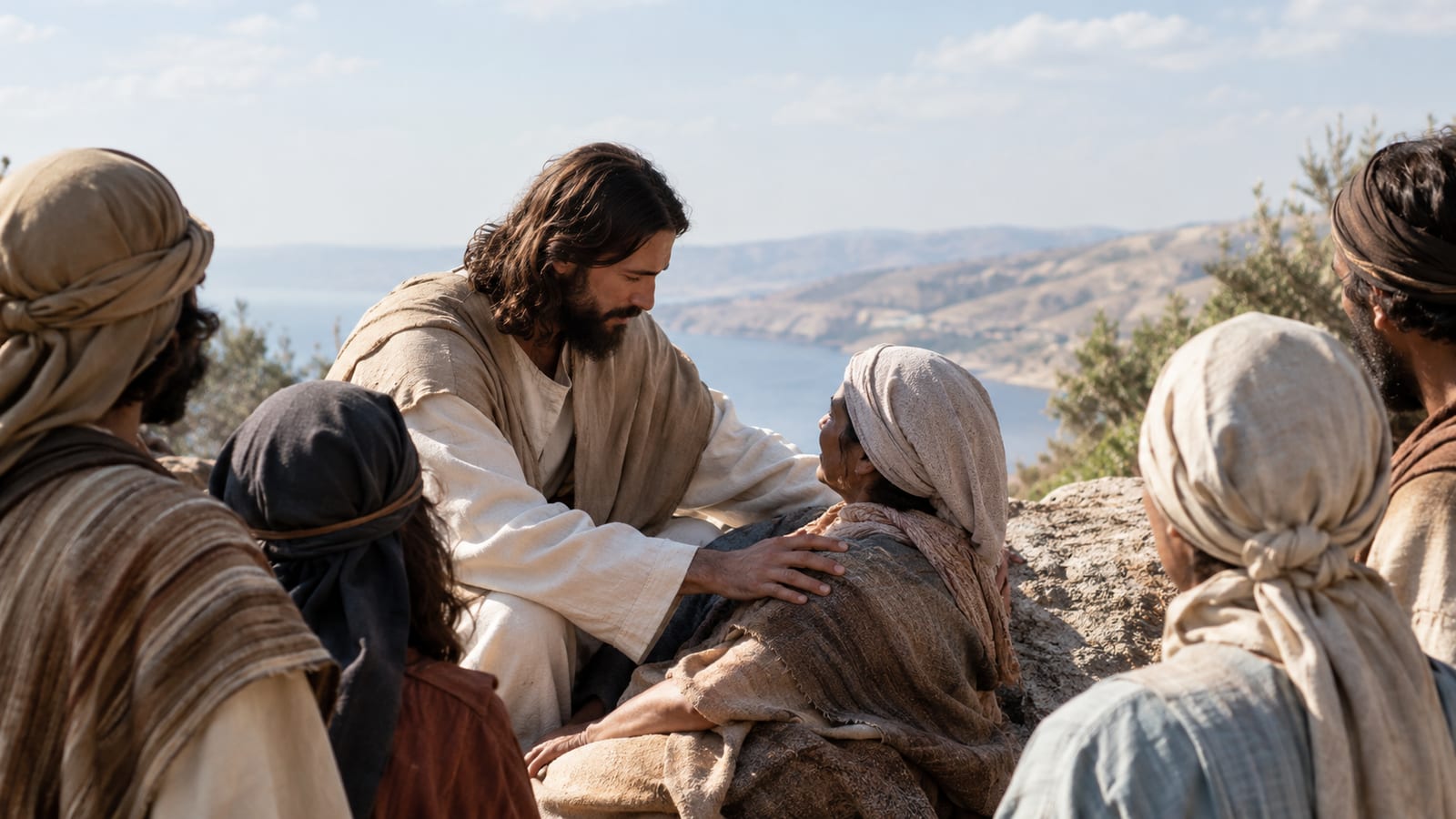
Jesus healed because he is compassionate. Matthew 14:14 says he saw the crowd, had compassion, and healed their sick. The suffering were never interruptions to his real work.
His healings also showed that God’s kingdom had arrived. In Luke 7:22, Jesus pointed to the blind seeing, the lame walking, and the poor hearing good news. Each healing was a sign of the world God intends to restore.
Still, the Gospel accounts do not say that every sick person in the Roman Empire was healed. Jesus’ miracles revealed his identity and authority. They were signs of the coming kingdom, not a standing promise that every believer will recover before death.
Christ also welcomed people others avoided. Mark 1:40-42 says he touched a man with leprosy before healing him. Jesus did not treat a suffering body as dirty paperwork.
That changes how the church behaves. Prayer should come with presence, dignity, and patient care.
Does Isaiah 53 guarantee physical healing now?
No. Isaiah 53 promises a suffering Savior who bears sin and brings us back to God. Physical healing belongs to Christ’s saving work, but the chapter does not guarantee immediate recovery from every present illness.
Isaiah 53:4 says the Servant bears griefs and carries sorrows. Matthew 8:16-17 applies that language to Jesus healing the sick. So bodily healing is part of the picture.
Yet Isaiah 53:5 also says he was wounded for our transgressions. First Peter 2:24 quotes the verse and applies it to dying to sin and living in righteousness. The center of the passage is the innocent Servant bearing the guilt of others.
The strongest objection is plain: “By his wounds we are healed.” Yes, and Scripture itself explains the healing as reconciliation, freedom from sin, and finally the restoration of the whole person.
The cross secures complete healing. First Corinthians 15:52-53 places that complete bodily renewal at the resurrection. Claiming that every cure must arrive now asks Isaiah to say more than Isaiah says.
What does James 5 ask the church to do?
James 5 calls the church to gather around the sick person with prayer, anointing, confession, and patient care. It does not describe a stage performance or a formula that forces God’s hand.
James 5:14-15 tells the sick person to call the church elders. They pray and anoint with oil in the name of the Lord. Then comes the promise: “and the prayer of faith will save the sick person, and the Lord will raise him up.”
Read the verses on either side of it. James 5:13 begins with suffering and praise. James 5:16 continues with confession, prayer for one another, and healing.
The elders represent the church’s spiritual care. Oil can mark consecration to God, and it also had ordinary caring uses in Scripture, as Luke 10:34 shows. The passage leaves room for both without turning oil into medicine with guaranteed results.
The prayer of faith trusts the Lord who raises the sick. It does not trust the volume of the prayer, the confidence of the elder, or the oil in the bottle.
If you request anointing, ask trusted elders to read James 5:14-15 with you first. Confess what needs confessing, explain your condition honestly, and let the church keep caring after the prayer ends.
Does healing include the body, mind, and heart?
Yes. Scripture treats people as whole persons whose bodies, thoughts, relationships, and spiritual lives affect one another. Luke 2:52 describes Jesus growing in wisdom, stature, and favor with God and people.
Physical illness needs bodily care. Meanwhile, fear may need patient prayer, wise counsel, sleep, food, and medical attention. First Kings 19:4-8 shows God giving exhausted Elijah rest and food before giving him further instruction.
Emotional pain should not be dismissed as weak faith. Psalm 42:5 records a believer questioning his downcast soul while still hoping in God. Faith and distress can sit at the same kitchen table.
Likewise, professional mental health care is not a rival to prayer. If you may harm yourself or cannot stay safe, seek immediate help and follow the National Institute of Mental Health crisis guidance. A crisis needs direct care, not a lecture.
Scripture also supports daily care of the body. These Bible verses about health and wellness address stewardship and wise habits without pretending every illness came from poor choices.
Do confession and forgiveness bring inner renewal?
Confession brings sin into God’s light, where forgiveness and renewal can begin. First John 1:9 says God forgives and cleanses those who confess.
However, not all sickness comes from personal sin. In John 9:1-3, the disciples assumed a man’s blindness had to be someone’s fault. Jesus rejected their explanation.
That warning matters. Do not make a sick person search for a secret sin to explain a diagnosis. Job’s friends tried that approach, and Job 42:7 says they did not speak rightly about God.
Still, James 5:16 connects confession, prayer, and healing. Hidden guilt can wound the conscience and damage relationships. If you have lied, cheated, withheld forgiveness, or harmed someone, repentance belongs in your prayer.
Forgiveness does not erase wise boundaries. Romans 12:18 says to live peaceably “if possible,” which admits that reconciliation takes truth and cooperation. Forgiving an abuser does not require giving that person fresh access to harm you.
Grace first, obedience after. Confession is not a payment for healing. It is coming into the light because Christ has already opened the door.
How can you surrender pain, fear, and anxiety to God?
Tell God what frightens you. First Peter 5:7 says to cast your anxieties on him because he cares for you. The verse does not tell you to deny that anxiety exists.
The Psalms give you words when your own words are thin:
- Psalm 6:2 asks for mercy in weakness.
- Psalm 13:1 brings the long wait to God.
- Psalm 23:4 names fear in the dark valley.
- Psalm 42:11 speaks hope to a troubled soul.
- Psalm 56:3 chooses trust in the moment of fear.
Read the whole psalm, not only the line that fits on a card. Biblical prayer often moves through grief before it reaches quiet confidence.
You can also ask another believer to stay with you while you pray. Galatians 6:2 tells Christians to bear one another’s burdens. Sometimes faith looks like shoes by the door and a friend sitting in the next chair.
If the fear remains, keep seeking proper care. Philippians 4:6-7 promises God’s guarding peace, but it does not forbid counseling, medical treatment, or help with the conditions feeding your distress.
What does Scripture promise about healing now and forever?

God can heal now, and believers should ask him to do it. Yet Scripture makes the final restoration certain at Christ’s return, not before.
Here is the boundary:
| Passage | What Scripture promises |
|---|---|
| James 1:5 | God gives wisdom to those who ask |
| Philippians 4:6-7 | God gives guarding peace through prayer |
| Second Corinthians 12:9 | Christ gives sufficient grace in weakness |
| James 5:14-15 | The church should pray in faith for the sick |
| First Corinthians 15:42-44 | God will raise believers with imperishable bodies |
| Revelation 21:4 | Death, grief, crying, and pain will end |
God sometimes answers Christian prayers for healing through sudden recovery. He may also work through treatment, slow progress, changed circumstances, or strength to endure.
Paul prayed for his “thorn” to leave in 2 Corinthians 12:7-9. God did not remove it. Instead, Christ promised sufficient grace and strength within weakness.
That was an answer, though it was not the answer Paul requested. We should not rename every disappointment a miracle. Neither should we assume God was absent because the body remained weak.
Revelation 21:4 gives the answer no illness can finally defeat. God will wipe away every tear, and death will be gone. Christian hope ends with resurrection, not with learning to make peace with the grave.
Where does the Bible end and the Adventist reading begin?
The Bible clearly teaches that believers may pray for healing, use practical care, confess sin, support the sick, and trust the resurrection. Those claims rest on passages such as James 5:13-16, John 9:1-3, and 1 Corinthians 15:42-44.
Here is how Adventists read it. We stress whole-person care because Scripture speaks to the body, mind, relationships, and spiritual life together. First Corinthians 6:19-20 calls the body a temple of the Holy Spirit, so caring for health is faithful stewardship.
That emphasis is an Adventist conclusion drawn from the larger biblical pattern. It should never become a way to blame sick people. A careful diet is useful, but it is not a shield against every disease in a broken world.
Adventists also place healing inside the blessed hope of Christ’s return. Titus 2:13 names that hope, while 1 Thessalonians 4:16-18 connects it with resurrection and reunion.
You can check the denomination’s wording in the official Seventh-day Adventist beliefs. Then check every conclusion against the passages themselves. Scripture carries the final authority.
What should you do before next Sabbath?
Tell one trusted believer or church elder what is happening. Ask them to pray with you from James 5:14-16 and to keep checking on you after the first conversation.
Do not hide the practical need. Say whether you need a ride, a meal, help making an appointment, or someone to sit with you. Galatians 6:2 turns burden-bearing into shared work.
Then write one sentence you can pray each morning: “Father, please heal me, guide my care, and keep me faithful while I wait.” Put it where you will see it beside the kettle, medicine, or keys.
You do not have to carry suffering alone until you can explain it neatly.
FAQ
Is it wrong to pray for the same healing more than once?
No. Luke 18:1 teaches believers to pray and not lose heart. Paul also asked repeatedly for his affliction to be removed in 2 Corinthians 12:8.
Repetition becomes empty when it treats many words as a way to pressure God, as Matthew 6:7 warns. Repeated trust is different. Bring the same request back while remaining open to God’s answer.
Do I need special words for a healing prayer?
No. God responds to faith in Christ, not polished wording. Romans 8:26 says the Spirit helps believers who do not know what to pray.
A plain sentence is enough: “Lord Jesus, have mercy on me and help me.” Mark 10:47 records Bartimaeus making that kind of direct appeal, and Jesus heard him.
Can someone with weak faith ask God for healing?
Yes. In Mark 9:24, a father says, “I believe; help my unbelief.” Jesus does not turn him away for admitting mixed faith.
Bring God the faith you have, along with the fear that remains. The strength of prayer rests in the one hearing it.
Should I stop medical treatment after receiving prayer?
No. Scripture never commands a sick person to abandon wise care as proof of faith. Colossians 4:14 even identifies Luke as a physician, while Isaiah 38:21 records practical treatment alongside God’s answer to prayer.
Discuss treatment changes with the qualified person caring for you. Prayer asks God to guide the care; it does not make careful care unnecessary.