
Daniel is the Bible's clearest picture of someone who worked for a pagan government without bowing to it. He was a young Israelite from the royal or noble families of Judah. He was carried off to Babylon after King Nebuchadnezzar took Jerusalem, trained in Babylonian learning, renamed Belteshazzar, and made an adviser to kings. Through all of it he kept praying to the God of Israel. His Hebrew name means "God is my judge," and his whole life reads like a sermon on that name.
Who was Daniel in the Bible?
Daniel was a Jewish exile who rose to the top of the Babylonian and later Persian civil service and never traded his faith for the job. The book that carries his name tells his story in chapters 1-6 and records his visions in chapters 7-12. He lived long enough to see Babylon fall in 539 BC, when the city opened its gates to Cyrus of Persia.
He was a statesman by trade and a prophet by calling. Jesus called him "Daniel the prophet" in Matthew 24:15. So when you read the book, you are reading a working man's diary and a prophet's notebook bound together.
What does the name Daniel mean?
Daniel means "God is my judge." The Hebrew joins dan, to judge, with El, God. That name works like a thesis for the whole book.
Kings in Daniel judge people all the time. They sentence wise men to death, throw young men into fire, and sign laws that cannot be changed. Yet the book keeps handing the final verdict back to God.
Here is the verse that shows it most plainly. Daniel 4:17 says "the Most High rules the kingdom of men." In Daniel 5:27, Belshazzar hears his own verdict: weighed in the balances and found wanting. Then Daniel 7:10 opens the books in heaven's court.
So every time a king threatened him, Daniel's own name already held the answer. The man on the throne was never his final judge.
A young man from the royal line of Judah
The text says Daniel came from Judah's upper class, and that is about all it says. Daniel 1:3 tells the king's official to bring young men "of the royal family and of the nobility." Daniel 1:6 names Daniel among them and says they were of the tribe of Judah.
The text never names his father. It doesn't say whether he was a prince or the son of a court family. Later tradition fills in a royal pedigree, but check it for yourself and you'll find Scripture leaves the detail open.
What the text does describe is the kind of young man Babylon wanted. Daniel 1:4 calls them youths without blemish, good-looking, and quick to learn. In other words, Babylon took the best and brightest first.
That fits an older warning. In Isaiah 39:7, the prophet told King Hezekiah that some of his descendants would serve in the palace of the king of Babylon. Daniel's life is that warning come true.
How Daniel ended up in Babylon
Daniel came to Babylon in an early wave of captives, years before Jerusalem burned. Read Daniel 1:1-3 in context and the story is short. Nebuchadnezzar besieged Jerusalem and carried off some of the temple vessels, along with selected young men of Judah.
Now read the verses on either side of that moment. Daniel 1:2 says "the Lord gave Jehoiakim king of Judah into his hand." The text puts God behind the defeat, not behind Babylon's army. That's the first hint that this book is about who really runs history.
The larger story sits in 2 Kings 24-25 and 2 Chronicles 36. Judah fell in stages. Its people were taken in waves, and the city and temple were finally destroyed. Daniel was there for the opening scene, which means he spent nearly his whole adult life far from home.
Think about what that meant at seventeen or so. There was no going back for a visit and no letters from his mother. A new language greeted him at every door, and the gods of the people who'd beaten his nation were everywhere.
School in the king's palace

Babylon didn't put Daniel in chains. It put him in school. Daniel 1:4 says the young men were to be taught "the literature and language of the Chaldeans," which means the scholars and wise men of Babylon. Daniel 1:5 sets a fixed course of years, with food and wine from the king's own table.
Notice what Daniel did not refuse. He studied the books, learned the language, and sat the final review before the king. Daniel 1:17 says God gave these young men "learning and skill in all literature and wisdom," and gave Daniel understanding in visions and dreams.
That line settles a question many believers still argue about. You can learn a culture's knowledge without taking its gods. Daniel didn't pull out of the classroom. He drew his line somewhere else.
If you're at a secular university, or in training at a company with its own creed, this is your passage. Learn well and work hard. Then hold your line where God's word actually draws it.
Belteshazzar: the name Babylon gave him
Daniel 1:7 says the chief official renamed all of the young men. Daniel became Belteshazzar, and his friends became Shadrach, Meshach, and Abednego. One Bible dictionary dates the renaming to after he was taken into exile in 617 B.C.E. Other timelines place his deportation several years earlier, so treat the exact year as debated.
Don't confuse Belteshazzar with Belshazzar, the king in Daniel 5. The names look alike in English but belong to different men.
The new name honored a Babylonian god. Nebuchadnezzar says so in Daniel 4:8: Daniel was "named Belteshazzar after the name of my god." The name is usually explained as a prayer asking Bel, Babylon's chief god, to protect the bearer's life. Scholars still debate its exact form.
The point was not subtle. The same reference work says the purpose was evidently to naturalize Daniel and pull him away from the worship of Jehovah. A new name was meant to produce a new man.
It didn't work. The book mostly uses "Belteshazzar" when Babylonians are speaking or when it needs to explain who's who. Everywhere else, the narrator still calls him Daniel.
The first stand was over dinner
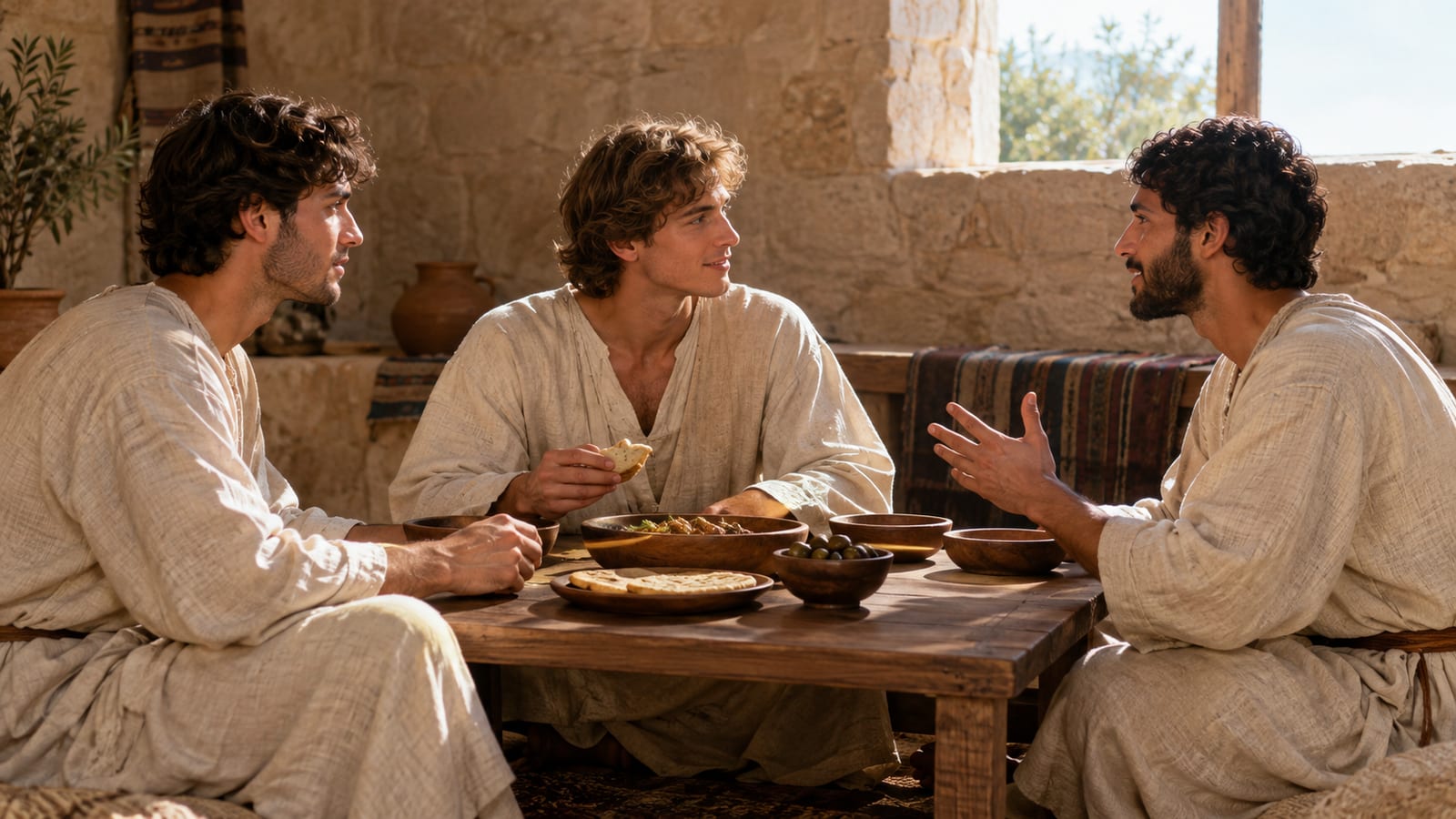
Daniel's first test of faith came at the dinner table. Daniel 1:8 says he "resolved that he would not defile himself with the king's food, or with the wine which he drank."
Watch how he went about it. He asked permission. When the official was afraid for his own head, Daniel proposed a short trial of vegetables and water and said, judge for yourself. He made a courteous request, not a protest. Daniel 1:15 says the young men looked healthier at the end of it.
Here is the strongest objection. Isn't this a lot of fuss over a menu? That is a fair question. The text treats it as more than a menu, though, because Daniel 1:8 calls the king's food defilement.
What the text doesn't say is why the food defiled him. Readers usually suggest a few reasons:
- The meat may have included animals that Leviticus 11 calls unclean.
- The food and wine may have been offered to Babylon's gods first.
- Eating from the king's table may have signaled total loyalty to the king.
Here is how Adventists read it. Daniel kept God's instructions about clean and unclean food and chose a simple diet. The church sees in that both obedience and a principle of health. You can follow that thread in our piece asking is a vegetarian diet biblical. Just remember the text gives the stand, and the reasons come from the wider Bible.
Small faithfulness came first in Daniel's life. The lions came much later.
Adviser to Nebuchadnezzar and the kings after him
Daniel served at the top of government under several rulers, and the book shows him keeping his post longer than most of his bosses kept theirs. Here is his career as the text presents it.
| King | Where to read it | What Daniel did |
|---|---|---|
| Nebuchadnezzar of Babylon | Daniel 1-4 | Interpreted the statue dream and the tree dream and was made ruler over the province of Babylon (Daniel 2:48) |
| Belshazzar of Babylon | Daniel 5, 7-8 | Read the writing on the wall and received visions of world empires |
| Darius the Mede | Daniel 6, 9 | Served as a top official, survived the lions' den, and prayed for his people |
| Cyrus of Persia | Daniel 1:21, 6:28, 10 | Was still serving and still receiving visions |
Telling kings what they didn't want to hear
Daniel's job was to speak plainly to dangerous men. In Daniel 4:27 he tells Nebuchadnezzar to break off his sins by doing what is right and showing mercy to the oppressed. That's a hard thing to say to a king who once ordered every wise man in Babylon killed.
In Daniel 5, Belshazzar offers Daniel gifts to read the writing on the wall. Daniel tells him to keep them and reads it anyway. Daniel 5:30 says Belshazzar was killed that same night.
For a long time, critics said Belshazzar never existed, because no other record named him. Then Babylonian inscriptions surfaced naming him as the son of Nabonidus, ruling in Babylon while his father was away. The Persian side of the story survives on the Cyrus Cylinder, a clay record of Cyrus taking the city.
Faultless enough to frighten his rivals
Daniel 6:4 is the best job review in the Bible. His rivals searched his work for something to charge him with and "could find no ground for complaint or any fault." The only thing they could attack was his faith.
The furnace and the lions' den
The book's great tests are all about worship, and each one asks who gets your knee.
In Daniel 3, Nebuchadnezzar set up a golden image sixty cubits high and six cubits wide. A cubit was about 18 inches, so the statue stood about 90 feet tall and 9 feet wide on the plain of Dura in the province of Babylon. Everyone was ordered to bow at the sound of the music.
Daniel isn't named in that chapter. His friends Shadrach, Meshach, and Abednego carry the test alone. Their answer in Daniel 3:17-18 is one of the bravest sentences in Scripture: God is able to deliver us, "but if not," we still will not bow.
The lions' den
Daniel's own test came in Daniel 6. His rivals talked King Darius into a law banning prayer to anyone but the king for a set period. Here is the verse. Daniel 6:10 says he went home, opened his windows toward Jerusalem, knelt, and prayed "as he had done previously."
Look closely at that last phrase. Daniel didn't stage a protest, and he didn't close the curtains either. He kept his ordinary habit, and his ordinary habit was enough to get him thrown to the lions. Daniel 6:22 says God sent his angel and shut their mouths.
Today the pressure usually arrives quietly. It might be a Saturday shift on the schedule, or a team meeting that runs into Friday evening. Daniel shows you the answer comes before the crisis, in habits built when nobody was watching.
When was Daniel born?
The Bible gives no birth year for Daniel. Daniel 1:4 calls him a youth when he arrived in Babylon, so he was likely in his teens. That's an inference, not a stated age.
The book dates events by the reigns of kings instead. Daniel 7:1 opens in the first year of Belshazzar king of Babylon. Daniel 10:1 places a later vision in the reign of Cyrus. Put those markers together and you get a life that ran from youth under Babylon into old age under Persia.
The fixed point everyone agrees on is the fall of Babylon in 539 BC. That event marked the end of a long era of Mesopotamian power. The date of Daniel's deportation is less settled. Different chronologies place it several years apart, depending on how they line up Daniel 1:1 with the records in Kings and Jeremiah.
Darius the Mede is another open question. Historians haven't firmly matched him to a name in Persian records. Some suggest a governor under Cyrus, and others suggest a title for Cyrus himself. I do not know which is right, and I'd rather tell you that than pretend.
Where the text ends and interpretation begins
The plain reading of Daniel tells you a great deal. Here is what the text says outright:
- Daniel was taken from Judah to Babylon as a young man (Daniel 1:1-6).
- He was trained, renamed, and promoted (Daniel 1:7, 2:48).
- He refused the king's food and prayed openly against a royal ban (Daniel 1:8, 6:10).
- He served kings of both Babylon and Persia (Daniel 1:21, 6:28).
- He received visions and wrote them down (Daniel 7:1).
Who wrote Daniel, and when
Authorship and dating are where interpretation begins. Chapters 7-12 speak in the first person: "I, Daniel." Daniel 7:1 says he wrote down the substance of his dream. The traditional view takes that at face value and holds that Daniel wrote the book in Babylon.
Many critical scholars disagree. They date the final form of the Book of Daniel centuries later, to the Greek period under Antiochus IV. Their main reason is that the predictions match history so closely. Notice that this argument assumes prediction is impossible before it starts.
How Adventists read the prophecies

Here is how Adventists read it. Daniel was a real prophet writing in exile, and Jesus confirmed that in Matthew 24:15. In chapters 2 and 7-12, God reveals through Daniel an outline of the world's major Gentile kingdoms, from Babylon to the end of history.
The method is called historicist. That means the symbols unfold in order across real centuries instead of collapsing into one short window at the end. Daniel 8:14 points to the cleansing of the sanctuary, which Adventists connect with Christ's work in heaven.
If you want that thread, start with reading Daniel's prophecies. Then move on to the four beasts in Daniel's vision. Hold every conclusion up to the text, the way Acts 17:11 says the Bereans did.
What Daniel's life asks of you this week
Daniel's faithfulness wasn't built in the lions' den. It was built at a window, on ordinary days. Grace first, obedience after: God gave him favor in Daniel 1:9 before Daniel had proven anything, and Daniel answered with a lifetime of steady habits.
Before next Sabbath, pick a fixed time and a fixed place to pray, and keep it every day. Make it a kitchen chair at six in the morning, or a parked car before you walk into work. Revelation 14:12 describes God's people as those who keep the commandments of God and the faith of Jesus, and that starts with a habit small enough to keep.
FAQ
Was Daniel a real person?
Ezekiel, who lived during the same exile, names Daniel twice. Ezekiel 14:14 lists him beside Noah and Job as a model of righteousness. Ezekiel 28:3 mocks the king of Tyre for thinking himself "wiser than Daniel." Some scholars link those verses to Danel, a hero in older Canaanite texts, though the spelling differs. Adventists read Ezekiel as speaking of his famous fellow exile.
Was Daniel a eunuch?
The text doesn't say. Daniel 1:3 puts the young men under the "chief of the eunuchs," and Isaiah 39:7 predicted royal descendants would serve in Babylon's palace. Still, the Hebrew word can also mean a court officer. Many readers assume Daniel was castrated, but the book never states it, so hold that view loosely.
Is Daniel one of the major prophets?
In English Bibles, yes. Daniel sits with Isaiah, Jeremiah, and Ezekiel, and "major" refers to the length of the books, not their importance. The Hebrew Bible files Daniel among the Writings instead of the Prophets. Our guide to the major and minor prophets explains how those groupings work.
Did Daniel ever go home to Jerusalem?
Scripture records no return. Cyrus let the exiles go back in Ezra 1, but Daniel was old by then, and the text leaves him in Persia. The last word God gives him in Daniel 12:13 is personal and gentle: go your way, rest, and you will rise to your place at the end of the days.