
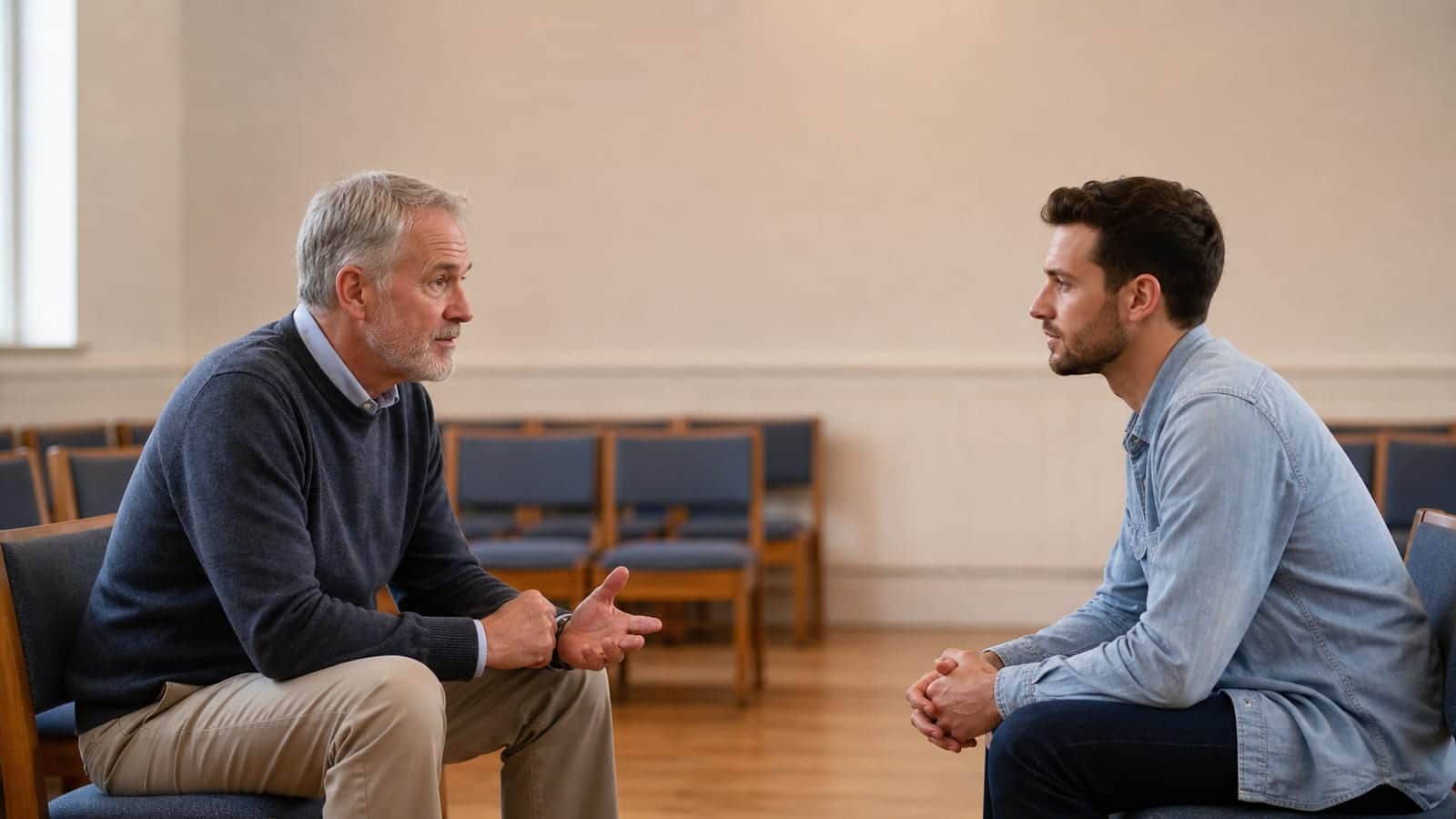
Pick the person whose life makes you want to open your Bible, not the one with the biggest audience. Finding the right mentor to grow in your faith comes down to three tests: their counsel holds up when you check it against the text, their life matches their talk when nobody is watching, and they keep handing you back to Jesus instead of keeping you attached to themselves. Look for that person in your own congregation first, in Sabbath School, in a small group, or through a name your pastor gives you. Get the three tests right and the rest is scheduling.
Last updated: 2026-08-01
What makes someone the right mentor to grow in your faith?
A spiritual mentor is a believer further along the road who helps you follow Jesus under the authority of Scripture. That is the whole job. He is not a life coach, a guru, or a substitute conscience.
Paul gives the pattern in 1 Corinthians 11:1: follow me as I follow Christ. Notice the second half of that sentence. The imitation has a limit, and the limit is Christ.
Luke 6:40 says a fully trained disciple becomes like his teacher. So look ahead ten years. If you became like this person, would that be good news? Answer honestly before you ask them for coffee.
What Scripture shows about learning faith from someone further along
Jesus started with proximity. Mark 3:14 says he appointed the Twelve that they might be with him. Time first, teaching after. They learned by walking with him, not by sitting through a course.
Paul told Timothy in 2 Timothy 2:2 to entrust what he had heard to faithful people who could teach others. The chain keeps going past the two of them. Mentoring in Scripture is never a closed loop.
Titus 2:2-5 puts it in the ordinary house: older men steady and self-controlled, older women teaching younger women what is good. Acts 18:26 shows Priscilla and Aquila taking the gifted preacher Apollos aside and explaining the way of God to him more accurately. They did it privately, and they did not humiliate him.
What does restoration look like when a disciple fails?
Look at John 21:15-19. Peter had denied Jesus, and the repair came through questioning and commissioning him three times, once for each denial. Every time, Jesus told him to feed his sheep.
So the restoration was specific, and it happened face to face. A mentor who only knows how to celebrate your wins is half-trained. You need someone who can sit with you after the failure and still give you work to do.
Where the biblical text ends and the Adventist reading begins
Here is the honest boundary. The Bible commands discipleship, counsel, and mutual correction. It never hands you a mentoring program, a curriculum, or a required number of meetings. Anyone who claims Scripture prescribes a system is adding to it.
Here is how Adventists apply it. We treat the seventh day as the natural rhythm for this work, because sundown to sundown gives you unhurried hours a weeknight cannot. Sabbath School exists for this kind of conversation, and it is where mentoring often begins in our churches.
We also read discipleship as whole-person work, body and mind and spirit together. We expect accountability inside a local church body rather than in private with one strong personality. You can read the denomination's own summary in the Adventist statement of fundamental beliefs. That emphasis is our application. Check it against the text yourself.
One more line to keep straight. Adventists hold Ellen White's writings as counsel that points to Scripture, never as a rival to it. Isaiah 8:20 is the rule for her and for your mentor alike: to the law and to the testimony.
The qualities worth requiring before you commit

Character first, and it is not close. The fruit of the Spirit in Galatians 5:22-23 is love, joy, peace, patience, kindness, goodness, faithfulness, gentleness, and self-control. Charisma is not on the list.
Matthew 7:16 says you know a tree by its fruit. So watch the tree for a season before you plant yourself under it.
| What to require | What it looks like in real life | How to check it |
|---|---|---|
| Submitted to Scripture | Changes a position when the text corrects them | "Tell me something you used to believe and dropped." |
| Steady character | Keeps small promises, calm when contradicted | Watch them under pressure, not on the platform |
| Sound teaching | Explains a passage with the verses around it attached | Ask them to walk you through a chapter |
| Confidentiality | No stories about other people's struggles | Proverbs 11:13. If they gossip to you, they gossip about you |
| Teachable humility | Has people who correct him and can name them | "Who tells you no?" |
| Free of money interest | Never mixes counsel with a sale | 1 Timothy 3:3 and Titus 1:7 |
The most useful question there is the one about correction. A mentor with nobody above him is not humble. He is unsupervised.
Warning signs that mean you keep looking
Some patterns disqualify a person no matter how gifted he is. Paul was blunt about leaders who exploit people in 2 Corinthians 11:20, and 1 Peter 5:3 tells shepherds not to lord it over those in their care.
- Control. They want the final say on your job, your money, your dating, your church attendance. Romans 14:4-5 leaves real room for conscience. So should they.
- Private doctrine. A teaching that survives on one verse, kept inside a small circle, with the group treated as the few who finally see it.
- Loose talk. Other people's confessions show up in your conversation. That is your future on the table.
- Money pressure. Urgency about giving, a business opportunity, or a personal loan.
- Fear and secrecy. You are discouraged from asking your pastor or your spouse about what was said.
- Boundary drift. Meetings get more private, more emotional, and harder to explain to anyone else.
If two or three show up together, you are not being mentored. Thank them, step back, and tell someone you trust.
How do you ask someone without making it awkward?
Pray first and get specific. Not "Lord, send someone," but "Lord, show me one person in this congregation, and give me one thing I need to grow in." Vague prayer produces vague asks.
Then look for the quiet, faithful people. The woman who has taught the same Sabbath School class for years. The man who shows up early to set up chairs and never mentions it. Proverbs 15:22 and 11:14 point you toward counsel, and steady service is easier to verify than eloquence.
Ask a pastor or elder for two or three names. They know who has capacity and who is already carrying too much. That one conversation saves you from asking the most exhausted person in the building.
What should the first ask actually sound like?
Make it small and concrete. "Could we meet once, for half an hour, so I can ask how you got into the habit of daily Bible reading?" One meeting is easy to say yes to. An open-ended commitment is not, and asking for it up front earns you a polite no.
If the first conversation goes well, propose a short season with a date to review it. Groups work too. Read why accountability groups matter in faith if one-to-one feels like too much right now.
Settle these questions in the first conversation
Write them down and ask them out loud. Awkward now beats confused later.
- What do you believe, and where do we differ? Do not assume agreement because you attend the same church.
- How often will we meet, for how long, and who initiates?
- What stays between us, and what would you have to tell someone else? Safety and abuse are the exceptions. Name them now.
- What do you expect of me between meetings?
- What happens when I disagree with you, or you with me?
- When and how do we end this well?
That last one gets skipped constantly. A mentoring season with no exit turns into an obligation neither of you can name.
What mentoring is not
Mentoring never replaces your own Bible reading. Acts 17:11 calls the Bereans noble because they checked Paul against the Scriptures daily, and Paul outranks your mentor. If your reading has quietly become "whatever he told me last week," something has gone wrong.
A mentor is not infallible authority either. Matthew 23:8-10 says one is your teacher. A good mentor will say "I do not know" and mean it, so be suspicious of one who never does.
Where does the mentor's help stop and your own load begin?
Mentoring is not therapy, and it is not a friendship where one person does all the talking. Galatians 6:2 says bear one another's burdens. Galatians 6:5 says each carries his own load. Both are true in the same chapter.
A mentor helps with the burden. He does not carry your load. If you cannot decide anything without calling him first, the relationship needs adjusting back toward Christ. That aim sits underneath what Christian discipleship really means.
When do you need a counselor or a pastor instead?
Some situations need qualified help, and a well-meaning mentor can do real damage by trying. Take it to a professional when there is abuse, trauma, addiction, suicidal thinking, severe depression or anxiety, legal exposure, or a marriage in crisis.
Loving your neighbor includes getting him the right kind of help. Prayer and a licensed counselor are not competitors. Bring your pastor in as well, especially where children or safety are involved.
A mentor's honest sentence in those moments is short: "This is past what I can help with, and I will go with you to find someone who can."
How to read and pray together without drifting into small talk

Pick one book and read it in order. Mark works well because the chapters are short and the story moves. Both of you read the same chapter during the week.
Then use three questions every time. What does the text say. What does it require of me. What will I do before we meet again. Read the verses on either side of anything that surprises you, because context settles most arguments before they start.
Pray specifically at the end. Not "bless our week," but the conversation you have been avoiding and the habit you keep losing. James 5:16 ties confession and prayer together for a reason. Next meeting, start by reporting back on the one thing. That habit separates mentoring from a standing coffee date, and how to support others in their faith growth fills in the rest.
What to do before next Sabbath
Name one person. Write the name down. He does not have to be the most impressive believer you know, only a faithful one a few steps ahead of you.
Then send one short message asking for half an hour. Bring one growth goal tied to a passage, something as ordinary as "I want to read a chapter every morning before work, and Psalm 119:105 is why."
Grace comes first and obedience follows, so do not approach this as a way to earn anything. You already belong. A mentor just helps you live like it on a Wednesday.
FAQ
Can a mentor be younger than me?
Yes. Paul told Timothy in 1 Timothy 4:12 not to let anyone look down on his youth, and Timothy pastored people older than himself. You need someone further along in the specific area you are asking about. A believer half your age who has kept a daily reading habit for years can teach you that habit.
What if my congregation is small and nobody seems available?
Widen the circle before you give up. Ask your conference youth or family ministries office, set up a video call with a member of a nearby church, or join a Sabbath School class in a larger congregation for a season. A biography of a faithful Christian is a poor substitute for a live person, but it beats waiting a year for perfect. Keep asking your pastor every few months, because people's capacity changes.
Should men be mentored by men and women by women?
For ongoing, personal, one-to-one conversation, yes, and Titus 2 assumes that arrangement. This is not about suspicion. It protects two reputations and one marriage. Mixed mentoring works fine in a group, in a class, or with spouses present. If a relationship has to stay hidden from your spouse to continue, it should not continue.
How do I end a mentoring relationship without hurting anyone?
Say it directly and kindly, in person if you can. "This season has done what I hoped, and I want to thank you rather than let it fade out." Mentoring is meant to run for a season anyway, which is why you agreed on a review date at the start. Drifting into silence is the version that actually hurts.
Do I have to tell my pastor I have a mentor?
You are not required to, but I would. It keeps the relationship inside the church body rather than beside it, and it gives you somewhere to go if the counsel starts feeling off. It also helps your pastor connect other people who are asking the same question you were.