

Biblical humility is a posture toward God, not a low opinion of yourself. Understanding the biblical perspective on humility starts there, because Scripture never asks you to shrink your gifts or talk down about good work you actually did. It asks for something harder: hand the whole self to God, live on his grace, obey his Word, and put someone else's good ahead of your own standing. Jesus is the model, and he set the bar at the cross.
Last updated: 2026-08-01
Two counterfeits get mistaken for the real thing. One is self-hatred. The other is the modest little deflection that goes fishing for a compliment. Neither one, however, is in the text.
What does understanding the biblical perspective on humility actually mean?
Micah 6:8 gives you the shortest definition in the Bible: act justly, love mercy, and walk humbly with your God. Humility there is a direction of travel. You walk with God, at his pace, on his road.
Philippians 2:3-8 makes it concrete. The Christian Standard Bible renders the command this way: in humility, consider others as more important than yourselves. Paul assumes you know what you're good at. His concern is whose interests go first when they collide.
Then 1 Peter 5:5-6 adds the posture and the timing. Humble yourselves under God's mighty hand, and he will lift you up at the right time. Notice who does the lifting. That single detail separates humility from a career strategy.
The Greek word behind Paul's command is tapeinophrosyne, which means humility or lowliness of mind. Four passages use it, and together they take about five minutes to read:
- Acts 20:19
- Ephesians 4:2
- Philippians 2:3
- Colossians 3:12
Read the verses on either side of each one. Every time, the word turns up in a passage about living with other people. Nobody in those chapters is examining his feelings; they're dividing up work, absorbing an insult, staying at a hard task.
The words behind the word
The Old Testament doesn't hand you one tidy term. It hands you several, and they pull in different directions on purpose.
Ani means poor, afflicted, in genuine need. Isaiah 66:2 says God looks to the person who is humble and contrite in spirit. Kana means to be brought low, to submit to a higher authority. Shachah means to bow down, the body doing what the heart already decided, as in Psalm 95:6.
The New Testament word tapeinos carries the same social weight, because it describes someone low in position, small in the eyes of the room. So when Romans 12:16 tells you to associate with the lowly, that's not a mood. That's a seating chart.
Here's the part modern usage drops. In Scripture, humility is regularly tied to your actual circumstances, not only to your attitude about them. As a result, the Bible expects it to show up in who you eat with.
God reads the inside first
1 Samuel 16:7 says people look at the outside, but the Lord looks at the heart. Psalm 51:17 tells you what he does with a broken and contrite heart: he doesn't despise it. That's a promise for the worst week of your life.
Matthew 6:1-6 closes the loophole. Jesus tells you to give and pray where nobody's watching, because an audience changes the transaction. Humility can be performed, and the performance is usually louder than plain pride.
So here's a test you can run this week. What do you do with the work nobody thanks you for? If the effort drops the moment the credit disappears, the credit was the point.
Poor in spirit means empty hands
Matthew 5:3 opens the Sermon on the Mount with a blessing on the poor in spirit, and the kingdom belongs to them. Jesus isn't measuring bank balances here. Low self-worth isn't the subject either.
The poor in spirit are people who have stopped pretending they brought something to trade. Think of walking into a kitchen where the meal is already made, the table is already set, and you didn't buy a single ingredient. You either sit down and eat, or you stand in the doorway explaining your résumé.
That's the whole posture. Empty hands, open, held out.
Why does God insist on humility before he gives grace?
James 4:6-10 teaches that God gives grace and shows favor to the humble, and it calls believers to humble themselves before the Lord. The reason isn't that God dislikes confident people. Grace has to be received, and a closed fist can't take anything.
Repentance says the problem is real and mine. Faith says the cure is real and his. Both sentences require you to stop defending yourself first, which is why pride blocks salvation while ordinary failure doesn't.
Now the correction, because this is where people go wrong. Humility buys you nothing. Grace first, obedience after. It's a gift, not a wage, and the moment you start keeping score of how humble you've become, you've wandered back to the checkout counter.
Jesus went the whole distance down
Philippians 2:5-11 is the passage to read slowly, in context, with the paragraph before it still attached. Paul says Jesus emptied himself by taking the form of a servant and being born in the likeness of men. Theologians call that self-emptying kenosis, which is a fancy label for a plain move: he let go of what was his by right.
Then it goes further. Paul writes that Jesus humbled himself by becoming obedient to the point of death, even death on a cross. That was the execution reserved for slaves and rebels, chosen deliberately by the one person who had never earned it.
Watch the order in the rest of the passage. He goes down, all the way down, and then God exalts him. The lifting is real. It just isn't self-service, and it isn't on your schedule.
That's the standard Paul sets for you in verse 5: have this mind among yourselves. Admiration was never the assignment.
Serving people who can't repay you

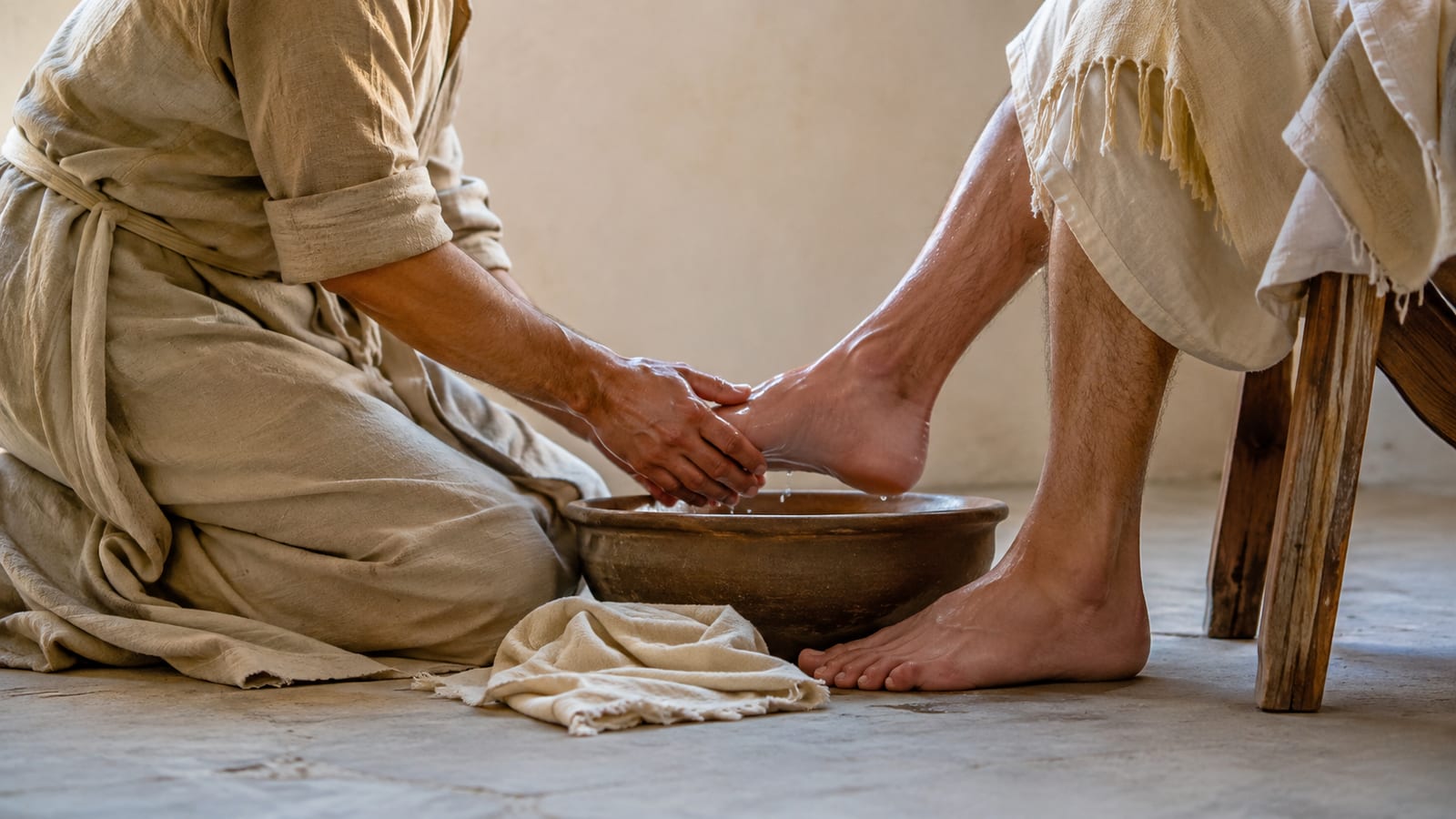
John 13:1-17 records Jesus washing his disciples' feet and telling the disciples to wash one another's feet. He knew where he came from and where he was going, and he still picked up the towel. Peter's objection is the honest one most of us feel, and Jesus overrides it.
Mark 10:42-45 gives the principle behind the basin. Rulers throw their weight around, and Jesus says it will not be that way among you. Greatness runs downhill in his kingdom.
The English Standard Version puts the working rule in Philippians 2:4: look not only to your own interests, but also to the interests of others. Paul says also, and the word does real work. He assumes you'll have interests of your own and asks you to widen the circle.
What this changes about your week is small and specific. Take the task with no visibility attached: the setup, the cleanup, the ride to the airport, the phone call to the person everyone finds difficult. If you want a fuller treatment, this blog's guide on serving others as a disciple works through the practical side, and serving God through your work applies it on the clock.
Taking up the cross without self-contempt
Luke 9:23 says to deny yourself, take up your cross daily, and follow him. Self-denial means surrendering the right to run your own life. It does not mean despising the self God made, the abilities he gave you, or the body you live in.
The difference shows in what you say no to. For example, biblical self-denial refuses sinful self-rule: the grudge you're nursing, the money you're shading, the ambition that treats people as steps. Self-contempt refuses the person, which helps nobody and honors no one.
One more thing that rarely gets said out loud. "Be humble" is sometimes used as a lever to keep someone quiet about real harm. Denying yourself never means letting another person sin against you unchallenged, because Jesus told the truth to powerful people constantly, and he was the humblest man who ever lived.
Pride and humility in the same situations
Proverbs 16:18 warns that pride goes before destruction and a haughty spirit before a fall. That's not a threat God enforces from the outside. Pride blinds you to what you need, and blind people trip.
Definitions stay blurry until you watch the two side by side in an ordinary week. Here's how they behave in the same five moments:
| The moment | Pride's move | Humility's move |
|---|---|---|
| Correction from your supervisor | Explain why they're wrong | Ask what you missed |
| A project goes well | Make sure the right people know who did it | Name who helped, by name |
| A mistake becomes public | Find the person to blame | Own it first, fix it second |
| Someone else gets promoted | Quietly downgrade them in your mind | Congratulate them out loud |
| A task you don't understand | Fake it | Ask, early, before it costs money |
Teachability is the tell. Pride wants agreement, humility wants accuracy, and only one of those grows over time. On how this shapes good judgment, see humility and wisdom together.
Where does the Adventist reading begin?
Everything above is in the text, and you can check it for yourself with an open Bible. Here's how Adventists apply it, and I want to mark the seam clearly.
The Sabbath is a weekly lesson in dependence. From sundown to sundown you stop producing, and meanwhile the world keeps running without your contribution. That's humility with a clock on it, though the fourth commandment doesn't use the word.
Foot washing is the sharper case. John 13 records the act and the command plainly. Adventist congregations practice an ordinance of humility before communion, and that specific form is a church's decision about how to obey, not a line of Scripture. Does the command bind every congregation to a literal basin? I don't know. The instruction is plain and the shape of the service isn't, and I'd rather say so than pretend. The broader Adventist positions are laid out in the Seventh-day Adventist statement of beliefs.
Adventists also read health and money as stewardship of things you didn't make and don't finally own. And readiness for Christ's return is a humility issue, because setting dates assumes you know what he said nobody knows.
One thing to do before next Sabbath
Pick the smallest real action, not the ambitious one you'll abandon by Wednesday.
- Read Philippians 2:3-8 out loud, slowly, once a day this week. Then pray it back in your own words.
- Name one area of pride specifically. If nothing comes to mind, ask the person who lives with you, and don't argue with the answer.
- Do one act of service nobody will ever connect to you. No mention of it later, no hint dropped, no story saved for Sabbath lunch.
Sabbath arrives better when you've already practiced sitting down at a table you didn't set.
FAQ
Can you be confident and humble at the same time?
Yes, and Paul is the proof. He spends chapters of 2 Corinthians defending his apostleship, yet calls himself the least of the apostles in 1 Corinthians 15:9. So confidence about what God handed you and dependence on God for all of it sit together without strain. What humility can't hold is contempt for people who have less.
Is turning down leadership a humble choice?
Sometimes. Just as often it's fear in better clothes. Moses argued at the burning bush and Gideon asked for proof twice, and God put both of them out front anyway. Before you decline, ask a plain question: is someone else genuinely better placed, or is the job simply uncomfortable and refusal the most spiritual-sounding way out?
Does God use hardship to humble people?
Deuteronomy 8:2 says God humbled Israel in the wilderness to show them what was in their hearts. Loss strips the padding off, and what's underneath becomes visible fast. That pattern is real in Scripture. Still, be careful aiming it at somebody else's grief, because diagnosing another person's suffering as divine correction is a job nobody assigned you.
How do I take a compliment without false modesty?
Say thank you, then stop talking. Deflecting usually pulls more attention your way than accepting would, and it hands the other person the awkward work of arguing with you. For example, "oh, it was nothing" makes a kind person say it twice. If God gave you the ability, waving it off isn't modest about you. It's dismissive about him.